REQUEST A QUOTE
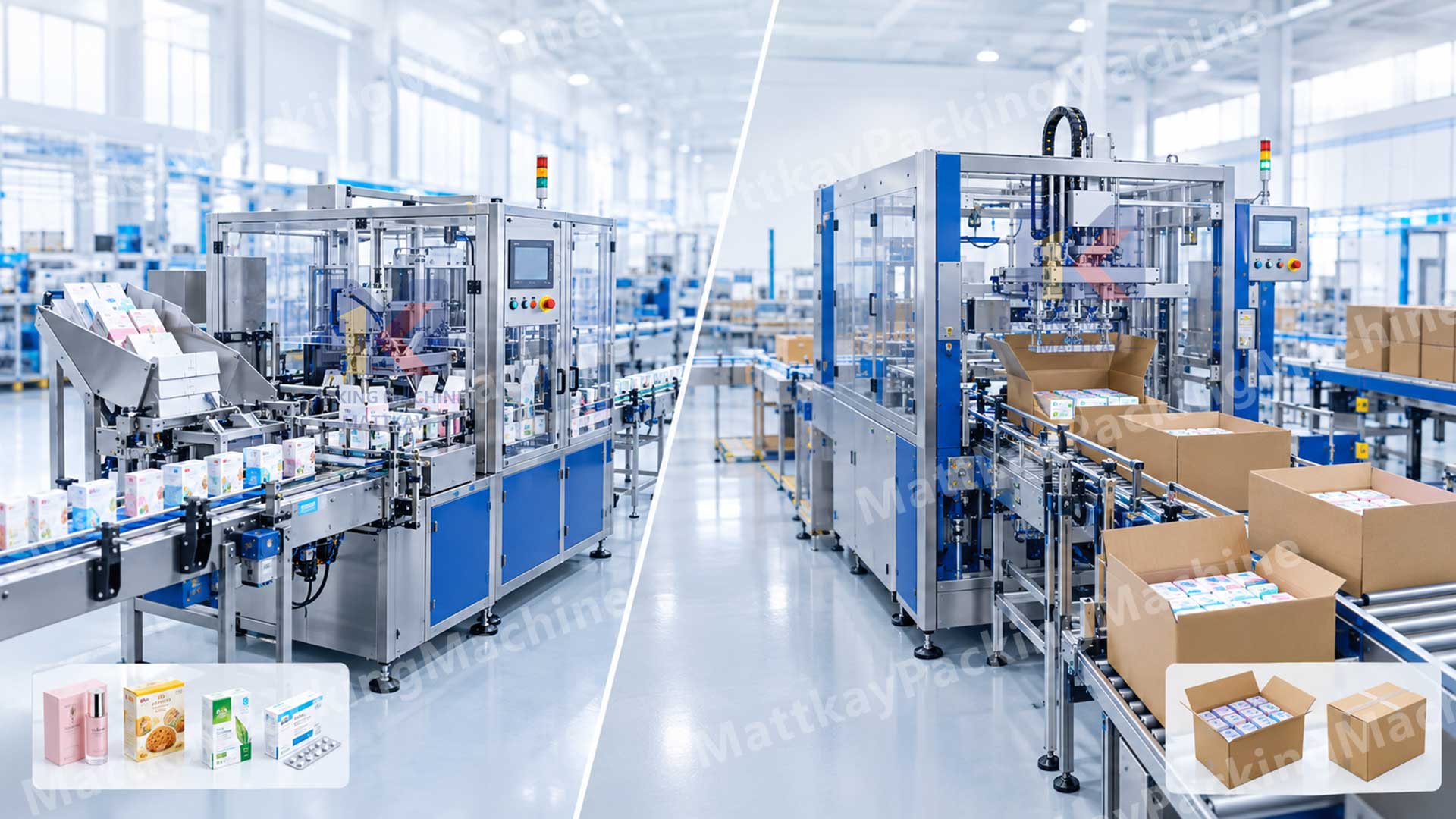
Cartoning and case packing are both important packaging operations, but they serve different purposes. A cartoning machine places products into individual cartons, while a case packing machine groups products or finished cartons into larger cases for storage and shipping.
Understanding the difference helps manufacturers choose the right equipment, avoid unnecessary investment, and design a more efficient packaging line.
A cartoning machine forms or opens a carton, loads the product, and closes the package. Depending on the machine design, cartons may be closed using tuck-in flaps, locking structures, or adhesive.
Cartoning machines are commonly used for:
The purpose is to create a finished carton that protects the product and supports retail presentation, handling, or further distribution.
Explore Mattkay's for automated carton packaging applications.
A case packing machine groups products into a larger shipping case or transport package. Depending on the system, it may load individual products, multipacks, trays, or already-finished cartons into cases.
Case packing is often used when manufacturers need to:
The specific machine design depends on the product arrangement, case dimensions, required output, and closure method.
| Feature | Cartoning | Case packing |
|---|---|---|
| Main purpose | Package products in individual cartons | Group products or cartons into larger cases |
| Typical input | Individual products, sachets, blister packs, bottles, or product groups | Finished cartons, multipacks, trays, or primary packages |
| Typical output | Individual product carton | Shipping or distribution case |
| Packaging material | Usually folding paperboard cartons | Often corrugated shipping cases, trays, or other case formats |
| Main focus | Product presentation, protection, and carton consistency | Grouping, transport handling, and distribution |
| Common line position | After primary packaging | Often after cartoning, or after primary packaging when cartons are not needed |
These are general differences. The correct equipment depends on how the finished package will be sold, handled, and shipped.
A cartoning machine is appropriate when products must be placed into individual cartons before reaching the customer, retailer, or next packaging stage.
For example, pharmaceutical companies may need to place blister packs into cardboard boxes printed with product information and sealed in a specific manner; food companies may need to box cookies, candy, coffee sachets, or nutritional supplements; cosmetics companies may need to package face masks, skincare products, and makeup tools; 3C electronics companies may need to neatly pack electronic components, accessories, and digital products into cardboard boxes; while hardware companies may need to automatically box screws, fasteners, and various small hardware parts. Different industries, product specifications, and packaging requirements all necessitate corresponding automated cartoning solutions.
Mattkay provides a wide range of for industries including pharmaceuticals, food, cosmetics, 3C electronics, hardware, stationery, toys, and daily necessities. Our machines can be customized to accommodate different product types, carton styles, and sealing requirements, and integrated with suitable upstream and downstream packaging equipment to create complete automated packaging solutions.
A case packer is appropriate when multiple products or finished cartons must be grouped into a larger package for transport or warehouse handling.
If the product does not require an individual retail carton, direct case packing may be sufficient, depending on customer and distribution requirements.
Some production lines require both operations:
Primary packaging → Cartoning → Case packing → Case sealing or labeling → Palletizing
The cartoner creates individual cartons, and the case packer groups those cartons into larger shipping units. Additional equipment depends on the factory’s packaging and logistics requirements.
Mattkay's automatic box-packing machine product page describes case-packing and sealing applications. Confirm the required case format and actual configuration with the engineering team before selecting equipment.
Provide product dimensions, weight, orientation, carton drawings, case dimensions, and packaging material specifications.
Calculate the required number of finished cartons and cases per minute. If both machines are used, the line must be balanced around actual operating speeds, changeovers, and stoppages.
Determine how many products belong in each carton and how many cartons or products belong in each case. Irregular shapes and unstable products may require special feeding or collation systems.
Check available floor space, conveyor direction, equipment interfaces, operator access, and downstream handling requirements before confirming the layout.
Compare equipment cost, labor, maintenance, material waste, changeover time, and expected production demand. Avoid choosing a machine based only on its advertised maximum speed.
Mattkay provides automatic cartoning equipment for applications across food, pharmaceutical, cosmetics, daily necessities, electronics, and other industries. Equipment selection depends on the product, carton format, target output, and level of automation required.
Learn more about Mattkay's packaging machinery capabilities or visit the official website to discuss your packaging project.
No. Cartoning places products into individual cartons. Case packing groups products or cartons into larger cases for handling and distribution.
No. Some products need individual cartons only, while others can be packed directly into shipping cases. Lines requiring both retail cartons and bulk shipping cases may use both machines.
Yes, when the machines and line layout are designed for integration. Product transfer, output rates, control signals, and jam handling should be considered during engineering.
Start with the packaging format required by your customer and distribution process. If individual cartons are required, evaluate cartoning first. If products only need grouping into shipping cases, a case-packing solution may be sufficient.