REQUEST A QUOTE
Choosing the right cartoning machine configuration is one of the most consequential decisions in a packaging line design. The two dominant architectures — horizontal cartoning machines and vertical cartoning machines — differ in how product enters the machine, how the carton is erected and closed, and ultimately how fast, how flexible and how expensive your line will be.
As a manufacturer of automatic cartoning machines since 2014, Mattkay (MTK) has built both configurations for food, pharmaceutical, cosmetic and industrial customers worldwide. In this guide, we break down the real-world differences so you can match the machine to your product — not the other way around.
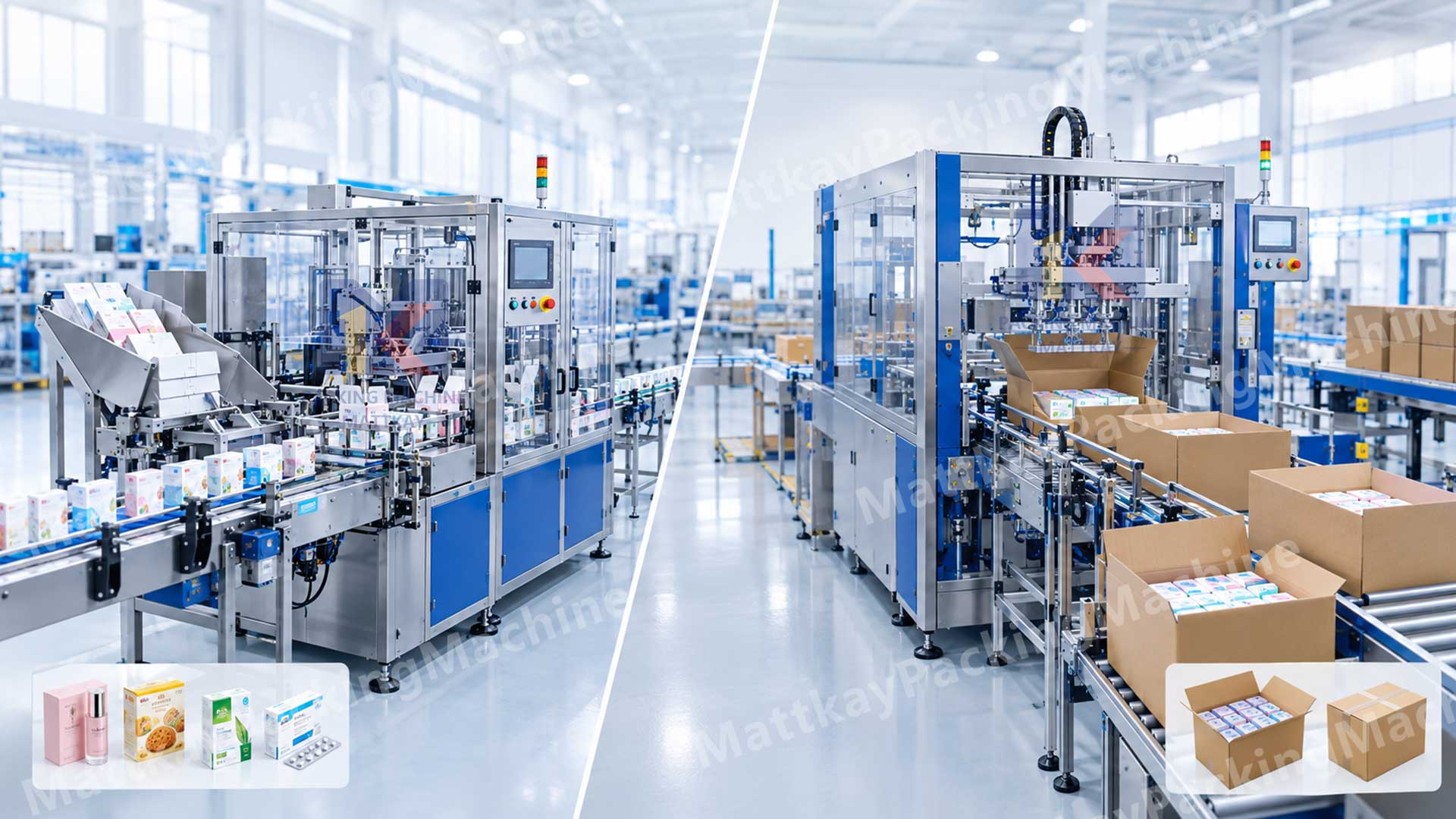
In a horizontal cartoner, the product is pushed horizontally into a carton that is erected with its opening facing sideways. The machine typically uses an intermittent or continuous motion bucket conveyor: product is loaded into buckets, carried to the opening of the erected carton, and pushed in by a pushing mechanism.
This configuration is the industry workhorse for products that are stable, rigid and flat-ish — think blister packs, sachets, biscuits flow-wrapped in film, pouches, and tubes. Horizontal machines dominate the pharmaceutical and food sectors precisely because these products feed naturally on their side.
If your product can be conveyed and pushed without tipping, spilling or deforming, a horizontal high-speed automatic cartoning machine will usually deliver the best combination of speed, gentle handling and footprint.
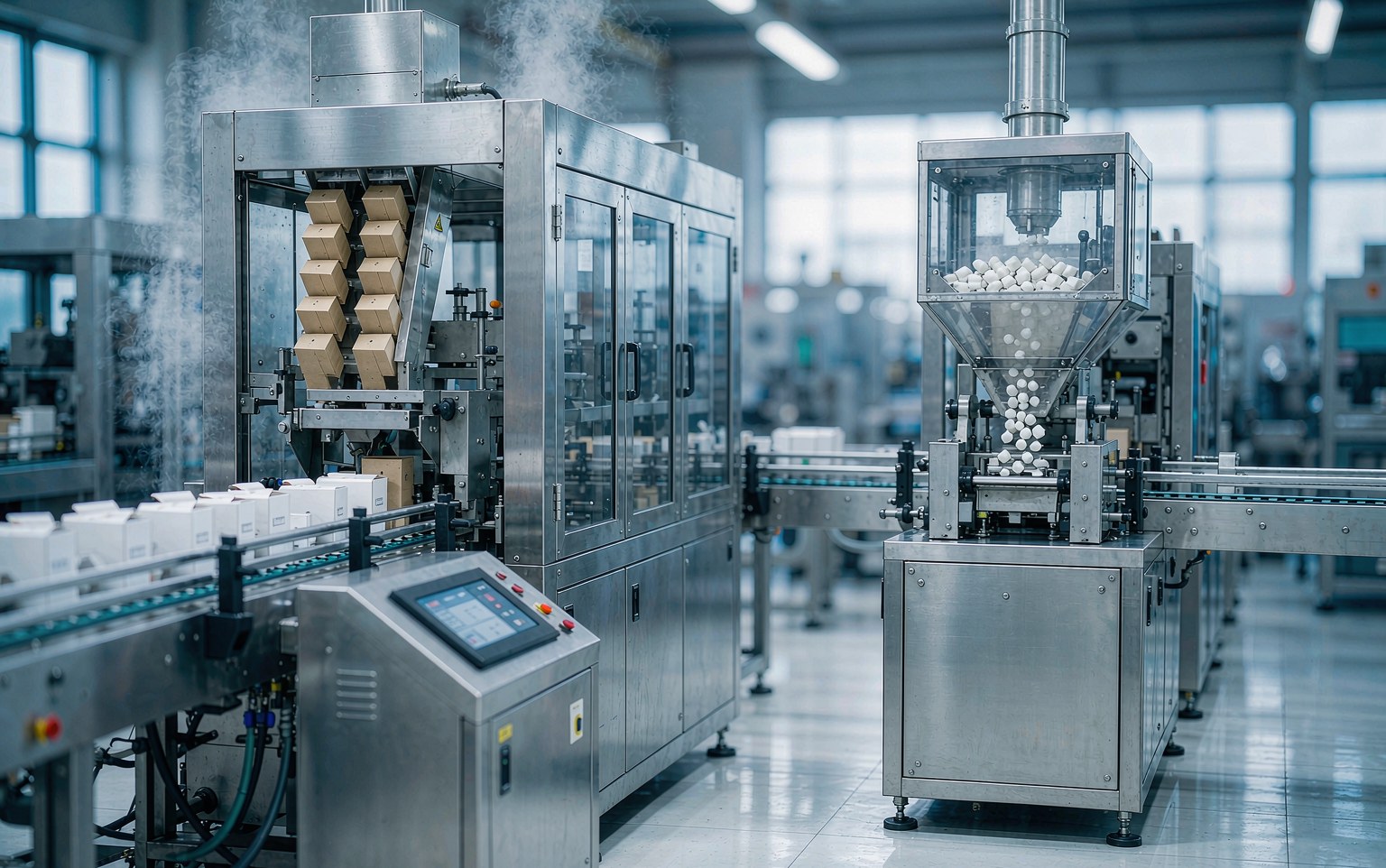
In a vertical cartoner, product drops or is placed downward into a carton erected with the opening facing up. Gravity does part of the work, which makes vertical machines the natural choice for loose, free-flowing or fragile products: granola, cereals, tea bags, candy, cosmetics jars, bottles with dosing cups, and anything that would fall apart if pushed sideways.
Vertical cartoners are also common where the carton must be filled with counted or weighed product from an auger or multihead weigher positioned directly above. Learn more in our overview of how automatic cartoning systems work.
| Criteria | Horizontal Cartoner | Vertical Cartoner |
|---|---|---|
| Typical speed | Higher (60–300+ cartons/min) | Lower to medium (20–120 cartons/min) |
| Best products | Blister packs, sachets, flow-wrapped bars, pouches, tubes | Cereals, candy, tea, jars, bottles, loose/free-flowing goods |
| Product entry | Pushed sideways into buckets | Drops downward by gravity or filler |
| Floor space | Longer footprint, narrower | More compact in length, taller |
| Gentle handling | Good for rigid items | Better for fragile/loose items |
| Integration | Easy to link with flow wrappers, thermoformers | Easy to link with weighers, auger fillers |
| Changeover | Fast with servo-driven size parts | Fast, often simpler tooling |
If yes, horizontal wins on speed and maturity of technology. If your product shifts, spills or deforms when tipped, vertical is usually safer and cheaper to validate.
Vertical machines pair naturally with auger fillers, vibratory counters and multihead weighers mounted above the carton. Horizontal lines pair naturally with upstream wrapped product from a flow wrapper or thermoformer.
Above roughly 100–150 cartons per minute, continuous-motion horizontal machines are the established answer. For mid-range speeds, both configurations compete — and the decision comes down to product behavior.
Horizontal machines run long but low, which suits linear plant layouts. Vertical machines trade length for height — check your ceiling clearance, especially with upstream dosing equipment.
Machine price is only part of the picture. Upstream feeding equipment, validation, tooling and changeover parts all affect the real number. For a detailed framework, see our automatic cartoner cost breakdown and pricing guide.
Pharmaceutical lid-box line: For a customer packing medicine cartons that open from the top, we supplied the MTK-VC160/VC260 top-opening lid box packing machine — a vertical-style solution chosen precisely because the top-open carton format rules out side-loading.
Food high-speed line: A biscuit producer running flow-wrapped product chose the MTK-200GS-H high-speed automatic cartoning machine in horizontal configuration, reaching stable output well above 150 cartons per minute with quick size changeover.
Cosmetics: For face mask and cosmetic sets where presentation matters, a horizontal machine with an integrated product-bucket system gives operators time to arrange product precisely before the pusher fires — a detail that vertical filling cannot replicate. See our automatic folding tray packaging machines for face masks as an example.
Remember that the horizontal-vs-vertical decision sits inside a bigger system design. Your cartoner must integrate with upstream equipment and downstream case packing. We covered the downstream choice in Cartoning vs Case Packing: What’s the Difference?, and the line-level view in How to Integrate a Cartoning Machine into a Production Line. If you are still weighing automation levels, our comparison of fully automatic vs semi automatic cartoning machines is a good next read.
Generally yes at the top end — continuous-motion horizontal machines exceed 300 cartons per minute in pharma applications. Vertical machines rarely exceed 120–150 cartons per minute because gravity feeding limits cycle rate. But at moderate speeds the difference often does not matter; product compatibility matters more.
Some hybrid designs exist, but they sacrifice speed and reliability. In practice, most manufacturers (including MTK) recommend committing to the configuration that matches your product physics and keeping changeover flexibility within that configuration.
Entry-level vertical machines are typically cheaper for low-speed applications. At higher speeds, horizontal machines deliver lower cost per carton despite a higher purchase price.
The fastest way: send us your product samples or dimensions. At MTK’s request-a-quote page, our engineers will review your product and recommend the configuration, speed class and line layout — free of charge, backed by 15+ years and 300+ completed projects.
There is no universal winner in the horizontal vs vertical debate — there is only the right fit for your product, your speed target and your plant layout. Horizontal cartoners win on speed and integration with wrapped products; vertical cartoners win on loose, fragile and gravity-fed applications. Get the product physics right first, and everything else falls into place.
Still unsure? Talk to our packaging engineers — we will help you spec the right cartoning machine in one consultation.