REQUEST A QUOTE
A new cartoner usually arrives on schedule. Then the schedule slips anyway. In most cartoning projects the bottleneck is not shipping — it is the two to four weeks between the crate landing on your dock and the line running at rated speed with an acceptable reject rate. Installation and commissioning is a project in its own right, with its own sequence, acceptance gates and paperwork. Skip a gate and you pay for it in cartons, in overtime, or in a warranty argument three months later.
This guide walks through the full sequence an automatic cartoning machine goes through after the purchase order: site readiness, the factory acceptance test, rigging and mechanical installation, the three commissioning runs, the site acceptance test, training, and the ramp-up metrics that show whether the investment is earning.
Suppliers often quote installation as a single line item — "ten days of engineer support, flights excluded." That line hides four distinct phases, each with a different owner, risk profile and document.
In one Gantt chart with named owners, a standard-speed cartoner goes from delivery to accepted in three to five weeks. Without that plan, the same machine takes two months and the plant pays the difference in overtime and delayed SKUs.
Site readiness is the cheapest phase to get right and the most expensive to get wrong. Every day an engineer stands in your plant waiting for a compressed-air drop is a day you pay for twice: in engineer time and in output you are not making.
A cartoner can only be proven on real packaging material. Ship the supplier 300 to 500 flat cartons and enough product for several hours of running, ideally from three board lots so lot-to-lot variation shows up early. If your carton style or board grade is still under discussion, settle it before the FAT — any change afterwards means re-validating settings you already paid to prove.
The FAT is the highest-leverage hour of the project, because it is the last moment when problems cost the supplier money instead of you. Be there, or join by video call with a fixed camera on the discharge conveyor — and do not accept a demo run on sample cartons the supplier keeps for exactly this purpose.
Video of each mechanism, the parameter sheet for every format, a PLC and HMI backup, the spare parts list with lead times, a signed report with measured numbers, and 50 retained cartons. Your maintenance team will open that folder the first time the machine misbehaves — long before the supplier's engineer can fly out.
Mechanical installation looks like the simple part and is where quiet, permanent losses are made. Agree the rigging plan in advance: crate weight, dock access, forklift capacity and the footprint marked on the floor. Unload, position and rough-level on day one while the crane is still on site — moving a machine twice is an expensive way to save an hour of planning.
Level the frame in both axes with shims or adjustable feet, then anchor as the manual requires. Match the upstream conveyor's line height — typically within a couple of millimetres — and set the transfer gap so products hand over without tipping. Check the outfeed against your checkweigher, labeller or case packer. Poor alignment does not stop a line; it makes it jam twice a shift for two years, and it sits behind many faults in our cartoning machine troubleshooting guide. On a multi-module line, coordinate the sequence with how to integrate a cartoning machine into a production line.
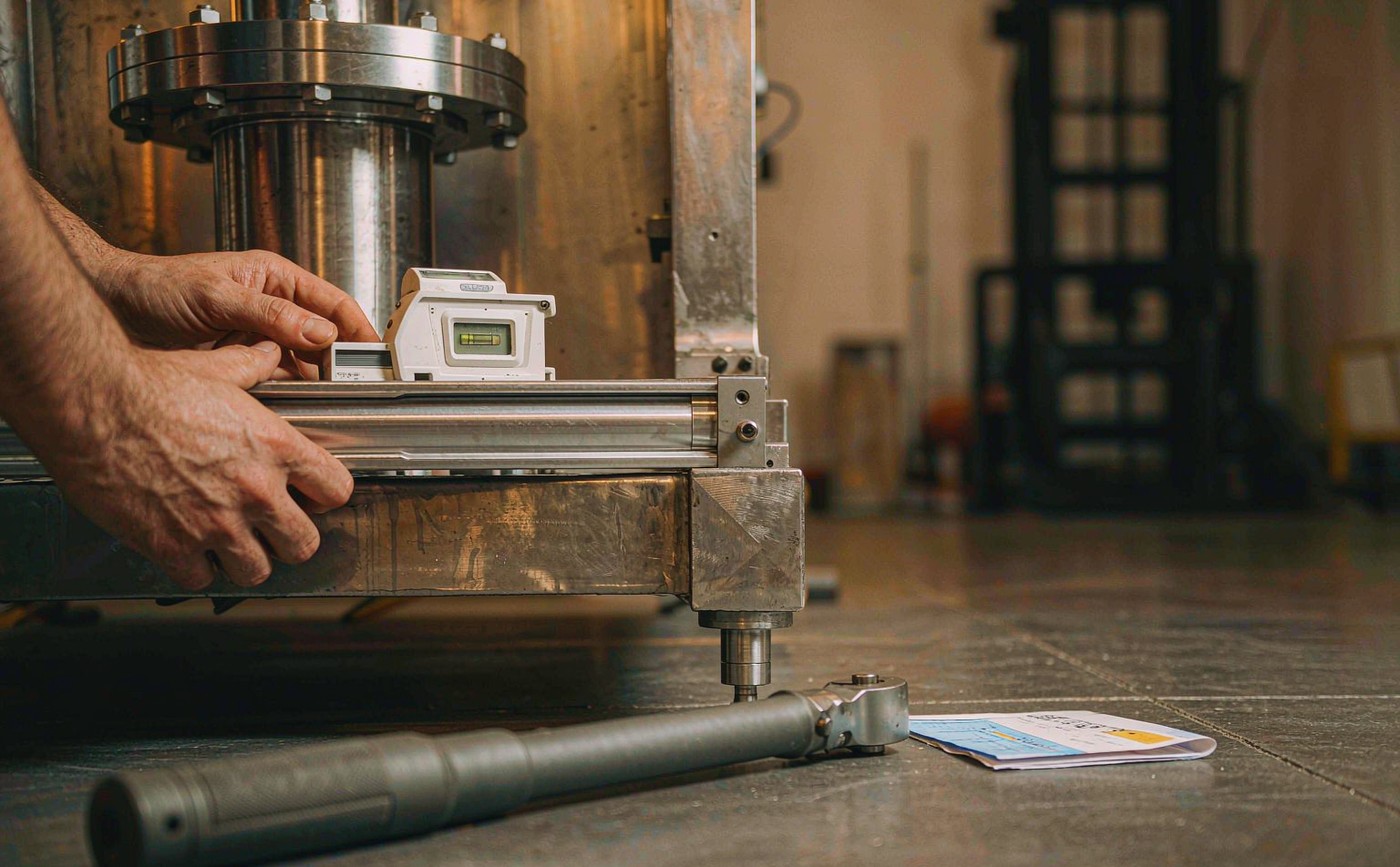
Commissioning is progressive validation, and the three runs should never be compressed into one.
Glue systems need patience: hot-melt must reach and hold its set temperature before the first carton, and nozzle pressure must be checked on the actual board. Operators should be at the HMI during the product run, hands on the screen — the settings they learn now are the settings they will defend at 3 a.m.
The SAT is the formal handover gate. It repeats the FAT protocol on your floor, with your operators, cartons, product and utilities — the four variables that changed. Run it over a full shift, recording output, reject rate, downtime events and glue consumption per thousand cartons.
| Acceptance gate | Where | Typical duration | Pass criteria | Document produced |
|---|---|---|---|---|
| FAT | Supplier plant | 1–3 days | Rated speed sustained 30 min, reject <1%, safety circuit verified | Signed FAT report, PLC backup, videos |
| SAT | Your plant | 1–3 shifts | Rated speed on your cartons, reject <1.5%, no stop over 10 min | Signed SAT report, as-built settings, punch list |
| 30-day ramp-up | Your plant | 30 days | Speed attainment ≥90%, OEE tracked, punch list closed | Ramp-up KPI sheet, warranty start confirmed |
Criteria that only exist in an email are not criteria. Write the speed, carton specification, reject rate and product specification into the order, with what happens if the SAT fails: who pays for the return visit, and how many attempts are included. Confirm too what installation support is in the price and what is billed per day — those items are rarely complete in a cartoner cost breakdown.
Most installation disputes start with an unspoken assumption about who arranges what. Agree the matrix before shipping.
| Task | Supplier | Buyer |
|---|---|---|
| Layout drawing and utility requirements | Provides | Approves against real site |
| Utilities to the machine terminals | Specifies | Installs and tests under load |
| Unloading, rigging, levelling | Advises or performs | Arranges crane, forklift, access |
| Cartons and product for trials | Requests specification | Supplies on time, free of charge |
| Training and documentation | Delivers | Releases staff from production |
Operators need hands-on time with jam clearing, start-up, shutdown and format changes — two days per shift, not one day for the whole team, or the night shift inherits an undocumented machine. Mechanics need glue system maintenance, sensor teaching, belt tension and the settings behind the HMI. Supervisors need the recipe structure, KPI screen and escalation path. Film the sessions and keep the files with the machine documentation; turnover is inevitable.
Documentation should include manuals in your language, electrical and pneumatic schematics, the PLC backup, a spare parts list with lead times, the FAT and SAT reports, and warranty terms with the start date confirmed in writing.
Acceptance is a gate, not a finish line. Track five numbers weekly for the first month:
Start the preventive maintenance checklist on the day of acceptance, not at the first failure.
For a standard automatic cartoner, plan three to five weeks from delivery to signed SAT: a week for placement and hook-up, one to two weeks for trials, and a week of buffer. High-speed or multi-format lines with coding or line integration commonly need five to eight weeks.
Usually yes, if the new line is physically separated and utilities are tapped during a planned stop. Expect noise, drilling dust and restricted forklift access for a few days. Schedule the SAT outside a peak shipping week so operators can be released for training.
It depends on the cause and on your purchase order. If the machine does not reach rated speed on the specified cartons, the supplier normally bears the cost of correction and the return visit. If the cause is utilities, carton quality or product variation outside the agreed specification, the cost falls to the buyer. That is why carton and product specifications belong in the contract, not in an email.
Yes — at minimum the wear items: suction cups, glue nozzles, belts, blades and the sensors most exposed to dust. Ordering them with the machine is cheaper than an air-freight emergency later, and it halves the first unplanned stop.
A cartoner earns its payback in the years after installation, but the first three weeks decide how much of it you collect. Prepare the site before the crate arrives, test at the supplier's plant on real cartons, accept the machine against written numbers, and measure the first 30 days instead of assuming them. Teams that do this routinely reach rated output a month earlier than teams that treat installation as a logistics task.
If you are planning a cartoning line and want the installation, commissioning and training scope defined up front — including FAT and SAT support — send Mattkay your product and carton specifications for a quotation with the full commissioning plan attached. Our engineers will also review your cartoning machine production line layout and confirm utility requirements before you commit to a delivery date.