REQUEST A QUOTE
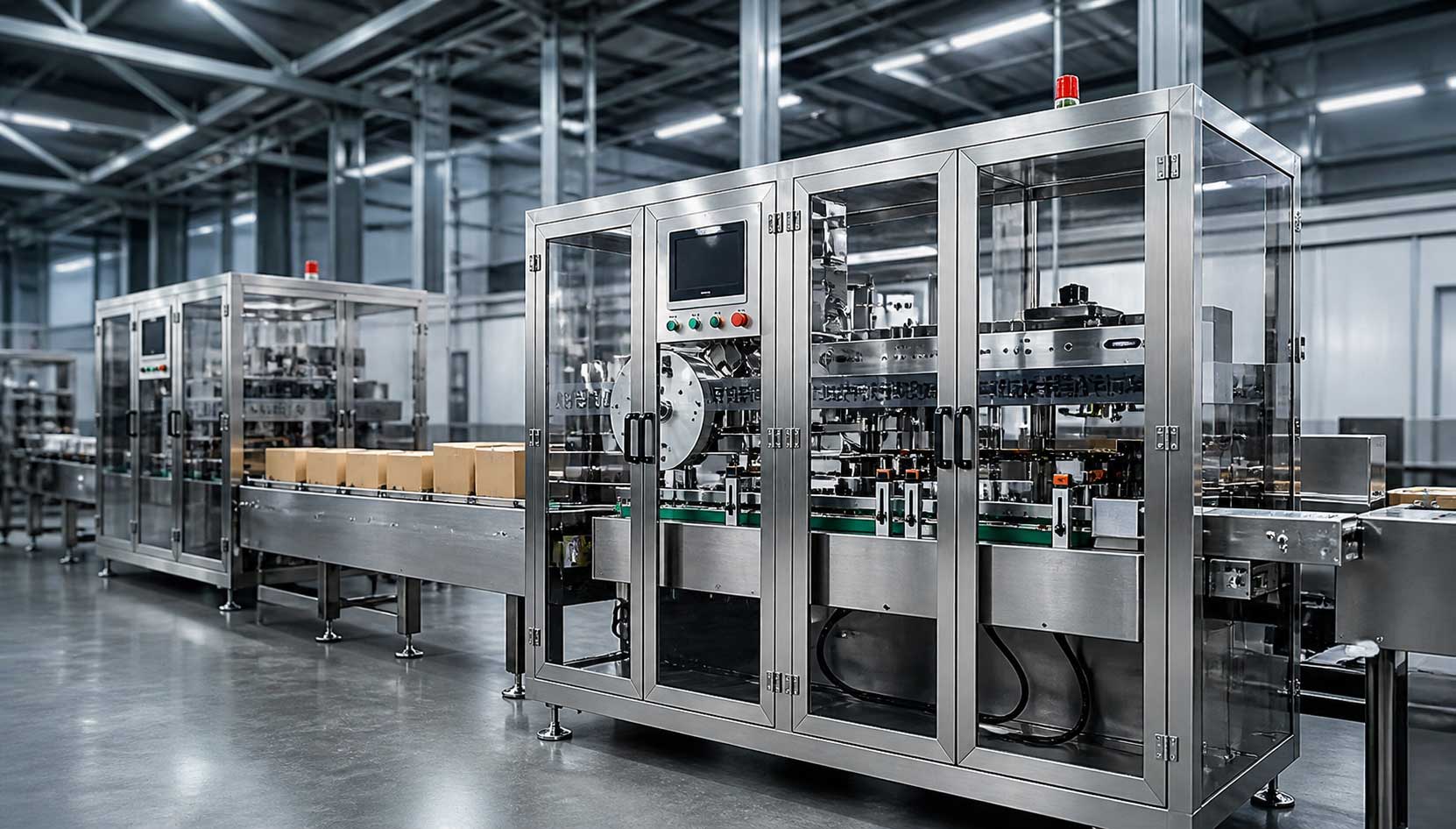
When you’re selecting the right fully automatic cartoning machine for your production line, it’s essential to assess your specific needs first.
Consider the types of products you’ll be packaging and their dimensions. Ensure the machine can handle varying sizes and weights without compromising efficiency.
Evaluate your production speed requirements; some machines work faster than others, affecting your output rates.
Don’t forget about the integration process with your current setup—look for machines that can seamlessly connect with existing systems.
Furthermore, think about ease of operation and maintenance; user-friendly controls and accessible parts can save time and reduce downtime.
Lastly, budget appropriately, keeping in mind both upfront costs and long-term operational expenses for the best overall value. Additionally, partnering with a provider that offers comprehensive lifecycle service can enhance your production efficiency and effectiveness.
A fully automatic cartoning machine is designed to efficiently package products into cartons without manual intervention.
You’ll find various types tailored to specific industries, and understanding these options is crucial for your decision-making.
As you explore factors like servo versus cam machines, you’ll see how these choices can impact efficiency and cost savings for your production line.
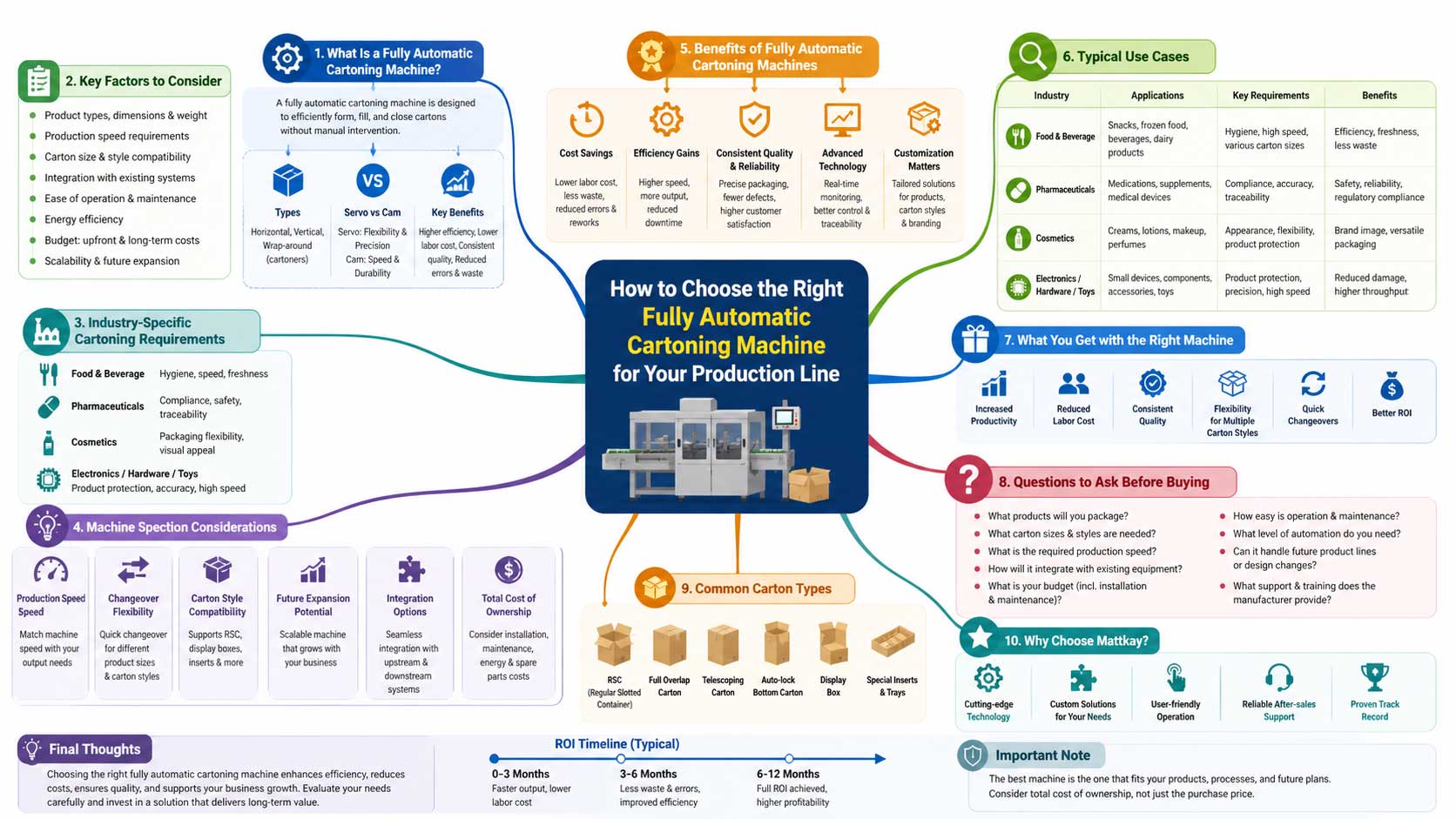
While exploring options, it's essential to understand that fully automatic cartoning machines come in various types, each tailored to different packaging needs and product specifications.
You’ll find horizontal, vertical, and wrap-around cartoners, with each designed for specific applications. Horizontal cartoners are great for larger products and often handle high-speed production. Vertical ones are ideal for lightweight items, as they efficiently pack from the top down. Wrap-around machines, on the other hand, are perfect for bundling or grouping products together.
Depending on your product size, shape, and desired output speed, selecting the right type can significantly impact your efficiency and overall packaging quality.
Assess your production line requirements to find the ideal fit for your business.
Before diving into the specifics of fully automatic cartoning machines, it's crucial to understand what they're and how they fit into your packaging process.
When considering a purchase, evaluate the machine's speed and efficiency to match your production demands. Check the size range it can accommodate to ensure versatility in packaging.
Maintenance is another key factor; look for machines that are easy to service and have reliable support from the manufacturer. Additionally, energy consumption can impact your operational costs, so selecting an energy-efficient model is wise.
Lastly, assess the machine's compatibility with existing equipment and software in your production line. These factors will significantly influence your decision and help streamline your packaging system.
Understanding industry-specific requirements is essential when selecting a fully automatic cartoning machine. Different industries have unique needs regarding packaging materials, dimensions, and handling specifications.
For example, pharmaceuticals typically require strict compliance with safety and traceability standards, while food and beverage packaging must prioritize hygiene and ease of access. If you're working in cosmetics, your cartoning machine should accommodate varying shapes and sizes of products.
Consider whether your production line demands high-speed output or flexibility for product changes. Knowing your industry’s regulations will help you choose a machine that meets both operational efficiency and legal compliance.
This awareness not only streamlines your production process but also enhances product safety and customer satisfaction.
When considering a fully automatic cartoning machine, you might wonder whether a servo or cam-driven system is better suited for your production needs.
Servo-driven machines offer precision and flexibility, allowing you to easily adjust settings for different carton sizes and shapes. They typically operate more quietly and require less maintenance due to fewer mechanical parts.
On the other hand, cam-driven machines excel in speed and durability, making them great for high-volume production. They're more straightforward in design, which can lead to lower initial costs.
Ultimately, your choice should depend on your production volume, budget, and the need for flexibility. Assessing your priorities will help you decide which system aligns best with your operational goals.
A fully automatic cartoning machine can significantly cut costs and improve efficiency in your packaging process.
By automating the cartoning task, you reduce labor costs since fewer employees are needed to manage the process. This means you can allocate your workforce to other critical areas, maximizing productivity.
Additionally, these machines increase production speed, allowing you to handle more cartons per hour compared to manual methods.
You'll also minimize material waste, as precise loading reduces errors and damages. Over time, the investment in a fully automatic cartoning machine can lead to substantial savings in operational costs, ultimately enhancing your bottom line.
Plus, you'll achieve consistent quality, which helps maintain customer satisfaction and repeat business.
Customization plays a crucial role in cartoning projects because it allows you to tailor the packaging solutions to meet specific product needs and branding requirements.
When you customize your fully automatic cartoning machine, you can optimize for different product sizes, shapes, and materials. This flexibility ensures that your packaging process runs smoothly and efficiently, reducing waste and minimizing downtime.
Plus, custom features might include unique carton designs or automated adjustments that enhance productivity. By aligning the cartoning system with your production goals, you also boost overall efficiency and maintain quality control.
Ultimately, a customized approach means your packaging not only protects your products but also strengthens your brand's identity in the marketplace.
Mattkay stands out as a leader in providing fully automatic cartoning machines that cater to the specific needs of your production line. You’ll appreciate our commitment to quality and innovation, ensuring that each machine is built with cutting-edge technology for maximum efficiency.
With a focus on user-friendliness, our designs simplify operation, letting your team adapt quickly. Plus, our machines are versatile, capable of handling various packaging types, accommodating any project you tackle.
When you choose Mattkay, you're not just buying a machine; you’re investing in a reliable partner dedicated to your success. Our unrivaled customer support is always there to assist, making maintenance and troubleshooting effortless.
Let's help you streamline your operations and enhance productivity today!
Fully automatic cartoning machines represent a significant advancement in packaging technology, streamlining the process of packaging products into cartons with unmatched efficiency.
These machines take the hassle out of manual cartoning, allowing you to focus on your production goals. With their ability to quickly form, fill, and seal cartons, they not only save time but also reduce labor costs and minimize errors.
Their versatility suits a wide range of products, adapting easily to changes in size or packaging design. Investing in a fully automatic cartoning machine can boost your overall productivity and ensure consistency in packaging quality.
As you explore the benefits of increasing productivity with advanced packaging technology, you might wonder what exactly a fully automatic cartoning machine is. Essentially, it’s a piece of equipment designed to efficiently form, fill, and close cartons without manual intervention.
This machine streamlines your packaging process by automatically folding boxes, inserting products, and sealing them—all at high speeds. Fully automatic cartoning machines boost production rates and reduce labor costs, making them an essential investment for any modern production line.
They’re versatile, able to handle various product types and carton sizes. With user-friendly interfaces and enhanced safety features, these machines assure both quality and efficiency, helping you keep pace in today’s competitive market.
Fully automatic cartoning machines offer a range of key benefits tailored to your production needs.
Depending on whether you choose a vertical or horizontal cartoning machine, you'll find various options for product types and feeding methods.
Understanding carton style compatibility and required production speed will help you make the best decision for your operation.
A vertical cartoning machine stands out as a powerful tool for streamlining packaging processes. If you're looking to enhance efficiency, this type of machine can save you time and labor costs.
With its ability to handle various product sizes and shapes, you can easily adapt it to your production needs. The vertical layout allows for a compact design, maximizing floor space while maintaining speed and precision during operation.
You’ll also appreciate the automation features, which minimize human error and increase overall package quality. Plus, these machines often come with user-friendly interfaces, making it simple for you to monitor production and make adjustments as needed.
Looking for an alternative to vertical solutions? Consider the horizontal cartoning machine.
These machines have unique operating advantages that can enhance your production line's efficiency. They handle a wide array of product types, making them versatile for various packaging needs. The horizontal format allows for easier loading and integration with conveyor systems, minimizing manual labor and streamlining your workflow.
Plus, you'll find that they provide greater stability during the cartoning process, reducing errors and waste. Their compact design can save space on the production floor while still maintaining high-speed output.
When it comes to selecting a cartoning machine, understanding product types and feeding methods is crucial for maximizing efficiency.
You'll want to consider the nature of your products—are they fragile, solid, or liquid? Each type requires specific handling to maintain quality during packaging.
Also, the feeding method plays a vital role. Gravity feed, vacuum feed, or mechanical feed can impact speed and precision.
Think about your production line's layout; some machines are better for space constraints.
Evaluating your product type and their feeding requirements ensures that your chosen cartoning machine can handle your needs seamlessly while reducing downtime and potential waste.
This careful consideration will ultimately lead to a more effective packaging process.
When selecting a fully automatic cartoning machine, you’ll want to ensure it accommodates various carton styles, such as regular slotted containers (RSC), display boxes, and special inserts.
This versatility allows you to adapt to changing market demands and offers flexibility in packaging. You won't have to invest in multiple machines for different types, saving you time and money.
Additionally, a machine that supports various carton styles can enhance the overall efficiency of your production line, improving output without compromising quality.
How do you determine the required production speed for your packaging operation? Start by evaluating your current output demands.
Consider factors like the number of units you package daily and any peak times that may arise. You'll also want to analyze the speed of your existing processes and where bottlenecks occur.
Once you’ve identified these metrics, compare them with the capabilities of potential fully automatic cartoning machines.
Look for machines that can comfortably exceed your minimum speed requirements, allowing for future growth without compromising efficiency.
Remember, investing in a high-speed machine can drastically increase productivity, reduce labor costs, and enhance overall workflow.
Choosing the right speed ensures you meet customer demands and stay competitive in the market.
While many packaging operations face the challenge of frequent product changes, fully automatic cartoning machines offer remarkable changeover flexibility. These machines are designed to quickly and efficiently switch between different product sizes, shapes, and packaging styles, minimizing downtime.
You’ll benefit from easy-to-use controls that allow operators to adjust settings with just a few clicks, reducing the need for specialized training. Additionally, some machines use interchangeable parts that can be swapped out swiftly, further enhancing flexibility.
This means you can adapt to market demands and seasonal variations without major disruptions. The ability to change over quickly not only ensures a continuous workflow but also helps you maintain a competitive edge, allowing your production line to respond swiftly to changing consumer preferences.
As your business grows, the future expansion potential of fully automatic cartoning machines becomes a vital consideration.
Investing in a machine with scalability features ensures your production line can adapt to increasing demands without major disruptions. Many of these machines are designed to accommodate a range of product sizes and packaging styles, allowing you to diversify your offerings without starting from scratch.
Furthermore, they often come with upgrade options for speed and efficiency, enabling seamless integration of new technologies as they become available.
Fully automatic cartoning machines offer three key benefits for the food industry that can significantly enhance your packaging process.
First, they boost efficiency by automating tasks, allowing your team to focus on other critical areas.
Second, these machines improve packaging consistency, ensuring that every carton meets your quality standards and reducing product waste.
Finally, they enhance flexibility, easily adapting to different carton sizes and designs, which is crucial in the ever-evolving food market.
With faster production speeds and reliable operation, fully automatic cartoning machines can help you meet your production targets while maintaining the integrity of your food products.
Investing in this technology can elevate your packaging capabilities and ultimately improve your bottom line.
In the fast-paced pharmaceutical industry, fully automatic cartoning machines bring several advantages that can streamline your packaging processes.
These machines enhance efficiency by significantly reducing manual labor, allowing your workforce to focus on more critical tasks. You'll also notice a marked improvement in accuracy—less chance of packing errors means higher quality assurance for your products.
Additionally, these machines adapt seamlessly to varying product sizes, making it easier for you to handle diverse pharmaceutical items without investing in multiple systems.
Compliance with stringent regulatory standards becomes simpler too, as automatic machines often incorporate features that ensure proper packaging and labeling.
In short, investing in a fully automatic cartoning machine could drastically improve your production efficiency and product quality.
When it comes to the cosmetics industry, fully automatic cartoning machines offer a multitude of benefits that can revolutionize your packaging operations.
These machines enhance efficiency by streamlining the carton forming and packing processes, allowing you to boost production rates significantly. They minimize the risk of human error, ensuring that your products are packaged consistently and accurately every time.
With customizable settings, you can easily adapt the machine to handle various product sizes and shapes, making it versatile for your diverse range of cosmetics.
Additionally, fully automatic cartoning machines reduce labor costs and free up your workforce for more valuable tasks.
Ultimately, investing in this technology can enhance your brand's reputation for quality and reliability.
As your business expands into the electronics, hardware, or toy industries, investing in fully automatic cartoning machines can significantly enhance your packaging efficiency.
These machines streamline your production process, ensuring consistent quality and reducing manual labor. They handle various box sizes and shapes, giving you flexibility in packaging different products. Fully automatic cartoners can also improve your throughput, allowing you to meet increasing demand without compromising quality.
With features like error detection and real-time monitoring, they minimize waste and ensure your machines are running optimally. Plus, they enhance safety by reducing the risk of human error.
Investing in a fully automatic cartoning machine offers several key benefits that can elevate your packaging operations.
First, these machines dramatically improve efficiency, allowing you to package products at a faster rate than manual methods. This automation means you can allocate your workforce to other important tasks, optimizing productivity.
Second, you'll notice a significant boost in consistency and quality. Fully automatic machines minimize human error, ensuring each carton is securely sealed and accurately packed. This leads to fewer reworks and higher customer satisfaction.
Finally, modern fully automatic cartoning machines come equipped with advanced technology, providing better monitoring and control over your packaging process.
Cost savings are a significant advantage of fully automatic cartoning machines. By automating the cartoning process, you reduce the need for manual labor, which can cut labor costs substantially.
Additionally, these machines often operate with improved precision, minimizing product waste and reducing material costs over time. You'll also find that fewer errors lead to fewer refunds and reworks, further contributing to your savings.
Maintenance costs are typically lower as well, given that fully automatic machines are built with durability in mind. Investing in one of these machines means you can streamline your production line and maximize your budget, giving you more flexibility to allocate funds elsewhere in your business.
Along with significant cost savings, fully automatic cartoning machines deliver impressive efficiency gains that can transform your production line. These machines minimize labor-intensive tasks, allowing your staff to focus on more critical aspects of production.
With high-speed operation, they reliably process large quantities of products, significantly reducing cycle times. This increased throughput can help you meet tight deadlines and enhance customer satisfaction.
Moreover, automatic adjustments for various product sizes mean less downtime for setup changes. You'll also notice fewer errors and product misalignments, thanks to precise engineering and advanced technology.
When you need customization for your packaging, fully automatic cartoning machines stand out as a versatile solution. These machines can adapt to various sizes and styles of cartons, ensuring your products are presented exactly as you envision.
You can easily tweak settings to accommodate different packaging designs, from unique shapes to intricate graphics. This flexibility not only enhances your brand’s identity but also responds to market demands effectively. With quick changeover times, you won't experience lengthy downtimes as you adapt to new packaging requirements.
Additionally, incorporating features like adjustable sealing and sorting mechanisms makes it easier for you to maintain efficiency while meeting your customization needs. Embracing a fully automatic cartoning machine empowers your production line to innovate without limits.
Choosing a fully automatic cartoning machine not only meets your customization needs, but it also brings a range of core advantages that can enhance your production process.
First off, you’ll experience increased efficiency—these machines work faster, reducing bottlenecks while maintaining high output. Reliability is another key benefit; automated systems are designed to operate consistently with minimal human intervention, freeing up your workforce for other essential tasks.
You’ll also notice improved precision in carton forming and sealing, which minimizes wasted materials and ensures product integrity. Finally, maintenance requirements are typically lower compared to manual counterparts, as automation often includes self-diagnostic features.
How do vertical and horizontal cartoning machines differ in functionality and application?
Vertical cartoning machines typically work by positioning products upright, making them ideal for items like bottles and tall containers. They save floor space and offer precise carton placement, ensuring your package remains stable during the cartoning process.
On the other hand, horizontal machines load products lying flat, which is perfect for boxes, trays, or items needing side-by-side arrangement. This configuration allows for easier adjustment when dealing with varied product heights.
When deciding between the two, consider your product types, available floor space, and production efficiency needs. Each option offers distinct advantages tailored to specific applications within your production line.
While assessing the speed of a fully automatic cartoning machine, you'll find that these machines are designed to significantly enhance your production efficiency.
They can typically run at impressive speeds, often ranging from 30 to 150 cartons per minute, depending on the model and specifications. This rapid output not only boosts your overall productivity but also helps meet high demand in a timely manner.
Moreover, their consistency ensures that the quality of each packaged product remains uniform. With various settings and configurations, you can optimize their speed to align with your specific operational needs.
Ultimately, investing in a fast cartoning machine can lead to quicker turnaround times and enhanced profitability for your production line.
Can one machine really handle multiple carton sizes? Absolutely! When you invest in a fully automatic cartoning machine, you’ll find that many models are designed to accommodate a variety of carton sizes with ease. This versatility means you won’t need multiple machines cluttering your production floor or stretching your budget.
Most advanced cartoning machines come equipped with adjustable settings and changeover features, allowing quick size adjustments. This flexibility helps streamline your operations, reduces downtime, and maximizes efficiency.
Plus, being able to switch between sizes quickly means you can cater to different product lines without significant delays. So whether you're packing small boxes or larger ones, a single machine can adapt and keep your production flowing smoothly.
When considering typical use cases for a fully automatic cartoning machine, it's essential to think about the types of products you plan to package.
These machines shine in high-volume production settings, offering advantages like increased efficiency and reduced labor costs.
However, it’s also crucial to weigh their limitations to ensure they meet your specific needs.
As businesses seek greater efficiency in packaging, fully automatic cartoning machines have become essential in various industries. You’ll find these machines particularly useful in food and beverage production, where they efficiently box items like cereals, snacks, and beverages.
In the pharmaceutical sector, they package medication and supplements in compliance with strict regulations. Additionally, cosmetics companies rely on these machines for packaging beauty products like creams and lotions.
These machines are also perfect for electronics, securely boxing gadgets and accessories. If you're dealing with high production volumes, choosing a fully automatic cartoning machine can streamline processes across these applications, optimizing your workflow and ensuring consistency in your packaging efforts.
By choosing a fully automatic cartoning machine, you can significantly enhance your production efficiency and reduce labor costs.
These machines excel in a variety of sectors, like food and beverage, pharmaceuticals, and cosmetics. You won’t just speed up packaging; you’ll also ensure consistent quality and reduce the risk of errors.
With the ability to handle different packaging sizes and types, you’ll easily adapt to changing market demands. Plus, the automation minimizes the need for manual labor, allowing your team to focus on other essential tasks.
Over time, the investment in a fully automatic cartoning machine pays off through increased output and long-term savings, making it a smart choice for businesses aiming to thrive in competitive markets.
Although fully automatic cartoning machines offer impressive benefits, they come with certain limitations that may not make them suitable for every situation.
For example, these machines tend to excel in high-volume production environments but can struggle with lower-volume runs, where the initial setup cost may not justify the investment.
Additionally, if your products vary significantly in size or shape, you might face challenges in adapting the machine, which could lead to inefficiencies or costly downtime.
Moreover, maintenance and repairs can be more complicated and costly compared to semi-automatic options.
Lastly, if your production line needs frequent changes to packaging designs, fully automatic systems may not provide the flexibility you require.
Consider these limitations carefully before finalizing your choice.
Fully automatic cartoning machines shine in settings where high efficiency and speed are crucial. They’re ideal for industries like food and beverages, pharmaceuticals, cosmetics, and consumer goods.
If your production line requires quick packaging of products such as snacks, drinks, or medication, these machines can streamline the process. You’ll find them useful for complex packaging tasks that need precision, such as forming, filling, and sealing cartons seamlessly.
Additionally, they cater to high-volume outputs, perfect for businesses scaling up production. Users often favor them for their versatility to handle various carton sizes and configurations, making them a solid choice for diverse products.
Investing in these machines can significantly enhance your operational efficiency and meet growing market demands.
Unlocking the benefits of a fully automatic cartoning machine can transform your packaging operations.
With enhanced efficiency, these machines significantly speed up your processes, reducing labor costs and minimizing human errors.
You'll appreciate their ability to handle various box sizes and shapes, allowing for flexibility in product packaging.
Moreover, they ensure consistent quality, ensuring that every carton is sealed and labeled correctly.
This reliability can bolster your brand's reputation, as customers receive well-packaged products every time.
The automation means you'll often achieve higher output rates, aligning perfectly with your production demands.
Plus, incorporating advanced technology can provide real-time monitoring, giving you insights into your operations for continuous improvement.
Invest in a fully automatic cartoning machine, and watch your productivity soar!
While a fully automatic cartoning machine brings numerous advantages, it’s important to consider its limitations in certain use cases.
For small production runs, these machines mightn't be cost-effective due to their higher initial investment and operational costs.
Moreover, if your products have diverse shapes or sizes, adapting a fully automatic system can be challenging, requiring additional equipment or modifications.
In industries with frequent changes in packaging design, flexibility can be limited compared to semi-automatic options.
Finally, for delicate items, automatic machines may not provide the gentle handling needed, leading to potential product damage.
Assessing these limitations will help you determine whether a fully automatic cartoning machine is truly the right fit for your production line.
Understanding the specific needs of your production line is key when considering a fully automatic cartoning machine. Start by asking what types of products you'll be packaging. Are they fragile, bulky, or oddly shaped?
Next, consider your production speed requirements. How many cartons do you need to process per minute?
It’s also essential to think about the size and style of cartons you'll use—do you have specifications in mind?
What’s your budget for the machine, including installation and maintenance costs?
Finally, inquire about the machine’s adaptability. Can it handle future product lines or design changes?
Cartons come in various types, each designed for specific products and packaging needs. For instance, regular slotted containers (RSC) are versatile and often used for shipping and storage.
If you’re packaging fragile items, consider using telescoping cartons, which provide extra support. On the other hand, full overlap cartons offer increased strength and are ideal for heavier products.
If you're targeting consumer goods, consider auto-lock bottom cartons, as they offer easy assembly and secure closure. For products like cosmetics, you might want to use printed cartons to enhance branding.
Selecting the right carton type not only protects your product but also enhances your overall presentation on retail shelves. Make your choice carefully to optimize efficiency in your production line.
Choosing the right carton type is only the first step in optimizing your packaging process.
It's essential to consider your specific use cases when selecting a fully automatic cartoning machine. Different industries require varying speeds, sizes, and features. For instance, if you’re packaging pharmaceuticals, speed and hygiene may be paramount, while cosmetics might prioritize visual appeal.
Food producers often need machines that efficiently handle different shapes and sizes while ensuring freshness.
Assessing these factors helps you pinpoint the right machine for your needs. Don't forget the importance of scalability; as your production grows, your cartoning solution should adapt accordingly.
Taking these typical use cases into account ensures you choose a machine that perfectly aligns with your operational goals.
When evaluating a fully automatic cartoning machine, it's crucial to focus on the specific needs of your industry, as each sector presents unique challenges and requirements.
For instance, in the food and beverage industry, you’ll want to ensure hygiene standards and speed efficiency. In pharmaceuticals, precise handling and compliance with strict regulations are vital. If you’re in cosmetics, flexibility in packaging sizes may be your priority.
Consider your production volume and whether you need the machine for high-speed operations or smaller batches. Pay attention to how easy it's to switch between different carton types or designs, as this can impact your overall efficiency and response to market changes.
Prioritize these factors to find the best fit for your operations.
As you explore integration options for a fully automatic cartoning machine, consider how these systems can seamlessly interface with your existing production line. One common use case involves connecting the machine to upstream packaging equipment, like fillers and labelers, enhancing workflow efficiency.
You might also want to integrate with inventory management systems to ensure real-time tracking of materials and finished products. Additionally, connecting to a quality control system can facilitate automatic checks for product completeness and packaging integrity.
Integrating with your existing data systems allows for smooth transfer of operational insights, analytics, and reporting. These connections not only improve productivity but also reduce downtime and manual interventions, ultimately streamlining your packaging process.
A wide range of industries relies on fully automatic cartoning machines to streamline their packaging processes, each with specific requirements tailored to their unique products.
For example, if you’re in the pharmaceutical sector, you’ll need machines that accommodate various box sizes and ensure regulatory compliance. In food packaging, your focus might be on machines that handle temperature-sensitive items, maintaining product integrity.
Additionally, consider speed requirements—your production line may need high-output capabilities to meet demand.
You’ll also want to assess the machine's versatility; can it handle different shapes and materials?
Ultimately, understanding these requirements will help you choose a cartoning machine that fits your production needs while optimizing efficiency and minimizing downtime.
Many industries benefit from fully automatic cartoning machines, which enhance efficiency across various applications.
In the food sector, these machines quickly package snacks, frozen goods, and beverages, ensuring freshness while reducing manual labor.
The pharmaceutical industry uses them to carton medication, providing secure packaging that helps maintain product integrity.
Cosmetics companies rely on these machines to automate their beauty product packaging, ensuring consistent quality and appearance.
Additionally, electronics manufacturers benefit by securely cartoning small devices and components, minimizing handling damage.
By adopting a fully automatic cartoning machine, you can streamline your production process, improve accuracy, reduce labor costs, and ultimately boost your bottom line.
Consider your specific industry needs to make the best choice for your production line.
When selecting a fully automatic cartoning machine, it's essential to understand the specific requirements that fit your operational needs.
Consider the volume of products you plan to pack, as this will determine the speed and capacity of the machine. You'll also want to account for the size and type of cartons you'll be using, ensuring the machine can handle them without issues.
Think about the materials involved; some machines are better suited for heavier items or delicate products.
Additionally, evaluate the level of automation you need, from simple functions to more complex systems integrated with your production line.
Choosing the right fully automatic cartoning machine can significantly enhance your production process across various industries. These machines find typical use in pharmaceuticals, where speed and precision in packaging are critical.
In the food industry, they efficiently package items like snacks, beverages, and frozen goods while ensuring hygiene standards. Cosmetics manufacturers rely on these machines for their ability to handle various sizes and shapes of products, creating visually appealing packaging.
Additionally, you’ll see them in electronics, securely cartonizing delicate components. Regardless of the sector, fully automatic cartoning machines streamline operations, reduce labor costs, and maintain consistent product quality.
Understanding the specific requirements of your production line can significantly influence your choice of a fully automatic cartoning machine. Assess factors like packaging size, weight, and material.
Consider the speed at which you need to operate; high-demand lines may require machines that handle large volumes without sacrificing quality. Evaluate whether your products have variations that necessitate flexibility in the machine’s design.
You also should account for space constraints in your facility, as some machines require more room than others. Lastly, think about integration with existing equipment and control systems.
Your defined requirements can lead you to various applications for fully automatic cartoning machines. These machines are perfect for industries like food and beverage, pharmaceuticals, and cosmetics.
If you're packaging granola bars, bottles, or beauty products, a fully automatic cartoning machine streamlines your workflow, increases efficiency, and reduces labor costs. You’ll find these machines particularly useful for high-volume production, where quick and accurate cartoning is essential.
Additionally, they accommodate different box styles and sizes, allowing you to be flexible with your product offerings. Whether you're looking to improve packaging consistency or reduce product damage during transport, these machines can adapt to your specific needs, enhancing overall productivity in your operation.
When it comes to selecting a fully automatic cartoning machine, specific requirements are essential to ensure optimal performance.
First, consider the type of products you’ll be packaging. Different machines cater to various shapes and sizes, so assess your product dimensions thoroughly.
Next, think about your production speed; some machines can handle higher outputs suited for fast-paced environments.
You should also focus on the ease of operation and maintenance, as this will impact your workforce's efficiency.
Additionally, ensure that the machine complies with industry standards and can integrate seamlessly with your existing production line.
Finally, evaluate the available support and training from the manufacturer to ensure your team can operate the machine effectively.
A well-planned ROI timeline for a fully automatic cartoning machine can reveal substantial benefits in various typical use cases.
For instance, if you’re in the food industry, you’ll notice reduced labor costs and improved packing speed as soon as the machine’s operational. Within just a few months, you could cut down on waste and errors, leading to higher customer satisfaction.
In pharmaceuticals, complying with regulations and ensuring product integrity can enhance your reputation, translating into increased sales.
If you're packaging consumer goods, you may achieve ROI in under a year by boosting efficiency and cutting down on manual handling.
Monitoring these timelines can drive informed decisions about future investments and enhancements in your production line.
Custom solutions in fully automatic cartoning machines offer significant advantages tailored to specific industries and requirements.
By selecting a cartoning machine that aligns perfectly with your production needs, you can enhance efficiency and minimize downtime. For example, if you're in the pharmaceutical industry, a custom solution may include features for compliance with strict regulations.
If you handle fragile products, you can opt for a design that offers better protection during the packaging process. Additionally, custom solutions can improve operator ergonomics, leading to a safer and more comfortable working environment.
You'll also benefit from streamlined operations, as these machines can integrate seamlessly with your existing production line, boosting productivity and ensuring consistent quality in every packaging run.
You’ll discover that fully automatic cartoning machines are incredibly versatile, catering to a variety of industries and packaging needs.
In the food sector, they’ll efficiently package everything from frozen meals to snack bars, ensuring freshness.
In pharmaceuticals, they'll securely carton medications, minimizing contamination risks.
Cosmetics and personal care products benefit too, with machines that handle delicate items and intricate box designs.
For electronics, these machines ensure precise carton formation, safeguarding products during shipping.
Additionally, they’re ideal for household goods, packing items like cleaners or detergents swiftly.
In conclusion, selecting the right fully automatic cartoning machine is crucial for optimizing your production line. By understanding your product requirements and future needs, you can ensure flexibility and efficiency. Remember to consider speed, compatibility with existing equipment, and your budget, including installation and maintenance costs. With the right choice, you'll enhance productivity and streamline operations, setting your business up for success. Take your time to evaluate options, and you'll find the perfect fit for your production needs.