REQUEST A QUOTE
A cartoner that runs 120 cartons a minute can still be the slowest machine on your line — not because of its speed, but because of what happens between batches. Forty-five minutes of stripping, hunting for change parts, cranking rails by eye and running trial cartons, repeated eight times a week, removes six hours from a single machine. That is 15% of a 40-hour week, and it never appears on an invoice.
Cartoning machine changeover time is the most under-managed number in packaging. Buyers compare rated speeds and prices, then discover after installation that the machine spends a fifth of its life being converted between SKUs. This guide gives benchmarks by cartoner type, the six places the minutes go, and a SMED (Single-Minute Exchange of Die) plan you can run without new hardware.
Rated speed tells you what the machine can do in one uninterrupted run. Changeover tells you how often that run is allowed to happen:
Changeover loss (%) = changeover minutes per batch × batches per week ÷ available production minutes per week
A food plant running three SKUs over five days: eight batches a week, 45 minutes per change, 2,400 available minutes. That is 360 minutes lost — 15% of capacity. Add start-up scrap and two idle operators and the real cost approaches 20%. At 12 minutes per change, 264 minutes come back every week: two extra batches, or no Saturday overtime.
Changeover therefore behaves like a hidden price discount: two machines quoted at the same figure are not the same investment if one converts in 12 minutes and the other in 50. If you are still sizing the machine, start with what a cartoning machine actually does, because the mechanism type sets the floor on changeover time.
Most factories measure changeover too generously, which is why improvement projects never show results. The defensible definition is the window from the last good carton of the previous batch to the first good carton of the next batch at target efficiency, including cleaning, line clearance, documentation and first-off approval.
SMED splits every task in two. Internal work can only be done while the machine is stopped: stripping format parts, fitting new ones, adjusting rails, running first cartons. External work can be done while the machine still runs: fetching the next format kit, pre-setting a magazine, filling the leaflet magazine, printing labels, completing paperwork. Most cartoners lose 20–30% of their changeover to work classified as internal only because nobody prepared it in advance.
Every conversion decomposes into the same five stages, and the time profile is remarkably consistent:
Adjustment and trial are almost always the largest blocks, and they are pure waste: a machine that located parts on scales and counters would not need tuning by trial.
There is no single industry standard, because a validated pharmaceutical line and a mask-boxing line are not comparable. These ranges come from installed cartoning equipment: what most factories live with today, and what a well-executed SMED programme achieves on the same machine.
| Cartoner type | Typical changeover today | Realistic SMED target | Biggest time driver |
|---|---|---|---|
| Vertical intermittent cartoner (small tuck-end cartons) | 30–60 min | 8–15 min | Hand-cranked rail and magazine width |
| Horizontal end-load cartoner (glued cartons) | 45–90 min | 15–25 min | Bucket/chain lugs, plough and glue settings |
| High-speed continuous motion (200+ cpm) | 60–120 min | 20–35 min | Servo re-teach and timing verification |
| Bottle-lining / cosmetic cartoner | 40–80 min | 12–20 min | Bottle change parts and lining-tape path |
| Blister or pharma cartoner (validated) | 60–120 min | 25–45 min | Cleaning, line clearance and documentation |
| Mask / tray or multi-lane line | 30–60 min | 10–20 min | Lane pitch and tray magazine reset |
Treat the right-hand column as a target, not a promise. A factory below 15 minutes on a horizontal cartoner is world class; a factory at 45 minutes has 30 recoverable minutes per change — multiply that by your weekly batch count before assuming you need another machine.
The clock starts, then someone walks to the spares room looking for the rails for the 80 mm carton. Five to twelve minutes vanish before a part is removed. Every format needs its own labelled kit, stored at the machine.
Rails adjusted by feel produce the trial-and-error loop: run, look, adjust, run. A scale, a counter and a recorded position per SKU halve the time on the second conversion.
Carton pick-up is where most start-up scrap is born: cups too low, gate too tight, stack leaning. Pre-set the gate against a gauge block and mark cup height so it is set with one feeler, not ten wasted cartons.
Running cartons to find the fault consumes board, glue, product and the inspector's time. A six-point first-off checklist — carton squareness, glue pattern, insertion depth, leaflet fold, code position, seal quality — replaces twenty trial cartons with two. If faults persist, work through the common cartoning machine problems list rather than adjusting at random.
In pharma and food plants the machine is often ready before the paperwork is. Pre-print the batch record and first-off sheet during the previous run, and agree a fixed response window with QA. On validated lines this stage can be 40% of total changeover, so it belongs in the project scope.
Hot-melt residue and carton dust get cleaned while the machine is stopped, then again after the next run because the clean was rushed. Clean during the run where it is safe, and keep a scraper, solvent and lint-free cloths at the machine. A proper cartoning machine maintenance checklist should carry changeover-specific tasks.
Record the whole conversion on a tripod and log the timestamp of every activity. You will find the operators are not slow — the sequence is. Two recordings usually expose 80% of the waste.
List every task in two columns, then move everything that can happen before the stop into the external one: pre-staging the format kit on a trolley, pre-setting the magazine gate, pre-heating the glue pot, printing the first-off sheet. This step alone typically returns 20–30% with zero capital spend.
This is where design pays off. Duplicate the format set so nothing must be dismantled; replace hand knobs with quick-release levers carrying counters; add a gauge plate so rails locate on a datum instead of on judgement; store recipe positions in the HMI so servos travel to the right place at the press of a SKU button.
Run internal tasks in parallel where two people can work safely on opposite sides, with defined roles and a spoken hand-off. Replace bolts with quarter-turn fasteners, group tools on a shadow board, and turn the setup card into a one-point lesson with photographs.
Post the target time at the machine, chart every changeover, and review the three slowest monthly. Without this step the time creeps back within a quarter, because a shortcut that saved two minutes yesterday becomes standard practice tomorrow.
Changeover speed is far cheaper to buy than to retrofit. Put these on the quotation:
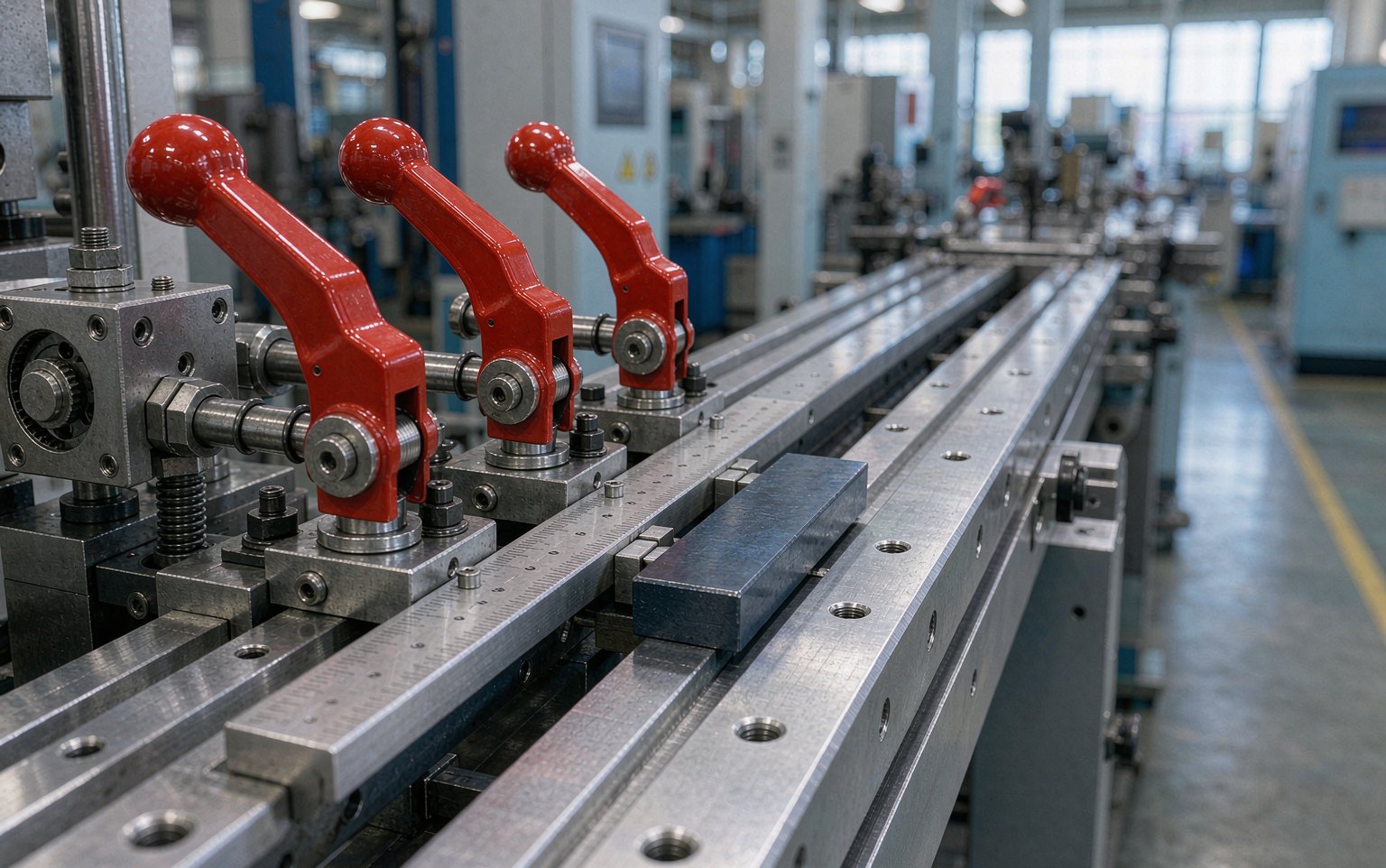
The last point matters most. Ask the supplier to demonstrate a complete changeover between two of your real carton sizes during the factory acceptance test, and time it. For a high-speed line, check the format-change provisions on the MTK-150H high-speed automatic cartoning machine; for top-opening lid boxes, the MTK-VC160 / VC260 lid-box packing machine follows a different changeover logic.
There is a real trade-off between speed and flexibility, and your SKU profile should decide it rather than the brochure:
If machine cost is the constraint, the automatic cartoner cost breakdown shows where changeover features sit in the price — usually a small fraction of the total, and the cheapest capacity you will ever buy.
Track four numbers monthly on one page: median changeover minutes per format, batches per week, start-up scrap per changeover, and first-off pass rate. Look for a falling median with a stable worst case — if the average improves but the slowest changes do not, the gain came from easy formats. One caution: faster changeovers invite smaller batches, which can raise total changeover time per week. Set a minimum economic batch size alongside the target.
For a standard horizontal or vertical cartoner running tuck-end cartons, 15 minutes or less is excellent, 25–30 minutes is competitive, and above 45 minutes is costing meaningful capacity. Validated pharmaceutical lines should target 30–45 minutes including cleaning and documentation. Compare against machines of the same type.
A 50–70% reduction is normal on the first programme, most of it from separating internal and external work and recording setup positions per SKU. Going below 10 minutes usually needs hardware: quick-release parts, datum pins or servo recipe memory. Reductions of 90% are possible but rare — they are bought rather than organised.
Yes, significantly. Tuck-end and reverse-tuck cartons usually need only magazine and rail adjustment. Lid-and-base or crash-lock formats add folding ploughs, glue nozzles and extra guides, so the format set is larger and the adjustment window wider.
Above four SKUs, servo recipe memory pays for itself quickly: it removes most of the adjustment stage and makes the change repeatable. With two or three formats on a mature mechanical machine, numbered scales, setup cards and gauge blocks deliver most of the benefit for far less money.
Before considering a second machine, measure the one you have. Record the next three changeovers with a stopwatch and split them into the five stages above — you will almost certainly find 20 minutes per change that a trolley, a shadow board and a setup card can recover. If the machine itself is the limit, send us your carton sizes, SKU count and batch sizes.
Request a quote with your SKU list and carton dimensions — the proposal will include the format-change design, the number of change part sets and a witnessed changeover, so the number you compare is capacity, not just price.