REQUEST A QUOTE
Ask a packaging engineer what stops a cartoning line most often, and the answer is rarely the machine. It is the carton — specifically the gap between the carton the spec sheet promises and the carton that arrives on the pallet. That gap lives in the die-cut tolerances: the small, permitted deviations in every blank’s dimensions. Tolerances that are too loose, or simply never measured, turn into magazine bridging, skewed cartons, missed tuck flaps and glue defects that look like machine faults. This guide explains what die-cut tolerances are, which dimensions matter on a cartoner, what bands are realistic, and how to inspect blanks before they reach the infeed.
Every die-cut carton blank is produced against a drawing with nominal dimensions — the exact crease-to-crease lengths, flap sizes and widths the designer intended. A die-cut tolerance is the permitted deviation from those values, expressed as a plus/minus band. A crease-to-crease dimension specified at 100.0 mm with a tolerance of ±0.25 mm may legitimately arrive anywhere between 99.75 mm and 100.25 mm.
Tolerances exist because no cutting process is perfect. Steel rules wear, make-ready pressure varies across the cutting plate, and paperboard swells and shrinks with humidity. Suppliers build tolerances into their quotations precisely so they can hold production economically. The problem arises when buyer and supplier never agree on which dimensions are critical, or when the buyer’s automatic cartoning machine was set up on blanks that sat at the middle of the band while production blanks drift toward its edges.
A half-millimeter deviation sounds harmless — until you follow a blank through a cartoner. The magazine, bucket chain or pusher feeder is set to the nominal blank: bucket pitch, vacuum pickup positions and pusher stroke are all dialed in against a first-article blank. A blank that arrives 0.5 mm long pushes its leading flap past where the machine expects it; a blank 0.5 mm short sits back from the registration stop. Either way, the folding stations, glue nozzle and tuck closing rails all strike the carton in slightly the wrong place.
Worse, the deviations stack. If the blank is long, the flap is long and the crease spacing has shifted in the same direction, a single carton can present the closing station with 1.5–2 mm of accumulated error. At 200 cartons per minute that is a new error every 300 milliseconds — and the machine responds with exactly the symptoms production teams blame on the cartoner.
Panel lengths control where every fold lands. The main panel length decides where the end flaps fold relative to the product, while the flap crease position decides whether a tuck lands on the panel face or short of it — whether your carton is a tuck end, reverse tuck or lid-and-base style. Panel-length error is cumulative: each panel adds its own deviation, so the total error at the closing rail can be several times the single-panel tolerance.
Flaps are the parts the machine actively handles — tucking rails press them, dust flaps interlock, glue flaps meet the nozzle. A tuck flap cut 0.5 mm short may still close on a hand-set line but misses the tuck rail timing on an automatic one; a flap cut long can bind in the closing rails and trigger jam detection. Tuck slit position matters as much as flap length, because the slit defines how deep the flap can seat.
Width errors show up as skewed cartons. If the side seam crease sits 0.5 mm off nominal, the tube forms off-center, and everything downstream — product insertion, end-fold alignment, the closure — inherits the skew. On glued cartons, a shifted side seam also moves the glue flap away from the nozzle path.
A crease is not just a line; it is a controlled weakening of the board. Scores set too shallow make folds resist and flap timing drift; scores set too deep crack the coating or the board itself, especially on recycled stock. Crease quality has no single number on most drawings, which is why it should be agreed as a visual standard or a fold test rather than left vague.
Blank squareness — how much the corners deviate from 90 degrees — is the quietest failure cause. A slightly rhomboid blank feeds crooked, which misaligns the first fold and propagates the skew through every station. Corner radius errors matter mostly on lid-and-base and display cartons where corners must nest cleanly.
The table below summarizes typical tolerance bands used across the industry for machine-fed cartons. Always treat your own machine supplier’s blank specification as the authority, and remember that tighter bands on heavy recycled carton board grades may cost more to hold.
| Blank dimension | Typical tolerance (machine-fed cartons) | Typical failure when exceeded |
|---|---|---|
| Critical crease-to-crease lengths | ±0.25 mm | Cumulative fold error, missed tucks, skewed closure |
| Flap lengths and tuck slit position | ±0.5 mm | Flap misses tuck rail, binding in closing rails |
| Blank width | ±0.5 mm | Skewed tube formation, glue flap offset |
| Side-seam crease position | ±0.5 mm | Off-center tube, product insertion interference |
| Score/crease depth (vs. set rule) | ±0.1 mm | Flap timing drift, board or coating cracks |
| Blank squareness (corner deviation) | 0.5 mm max over blank length | Crooked infeed, skew propagating to all folds |
Tolerance problems rarely announce themselves as "the carton is wrong." They present as machine symptoms. Watch for these patterns:
If these symptoms appear intermittently and move with a new carton lot — while machine settings were untouched — die-cut tolerances are the first thing to audit.
Cutting rules dull and nick with use. Wear shows up as gradual dimension growth on external cut lines and fuzzy edges on creases. A die approaching the end of its economic life can drift a full tolerance band on critical dimensions.
Paperboard is hygroscopic. Cartons stored in a humid warehouse can gain measurably in cross-grain dimension before they are ever fed. This is why storage conditions belong in the carton specification, and why blanks should be acclimatized in the packaging hall before a format changeover on a new lot.
Uneven cutting plate pressure produces uneven cuts across the sheet: one corner crisp, the opposite corner soft. A supplier’s make-ready discipline — and whether they check dimensions across the full sheet rather than one sample position — determines how consistent your blanks will be.
Most carton drawings mark every dimension the same way, but they should not carry the same tolerance weight. Split the drawing into two classes before signing off a new carton:
Ask the supplier to confirm, in writing, which dimensions they treat as critical and what their lot-by-lot inspection covers. A supplier who measures the drawing the same way your machine setter does will almost never surprise you.
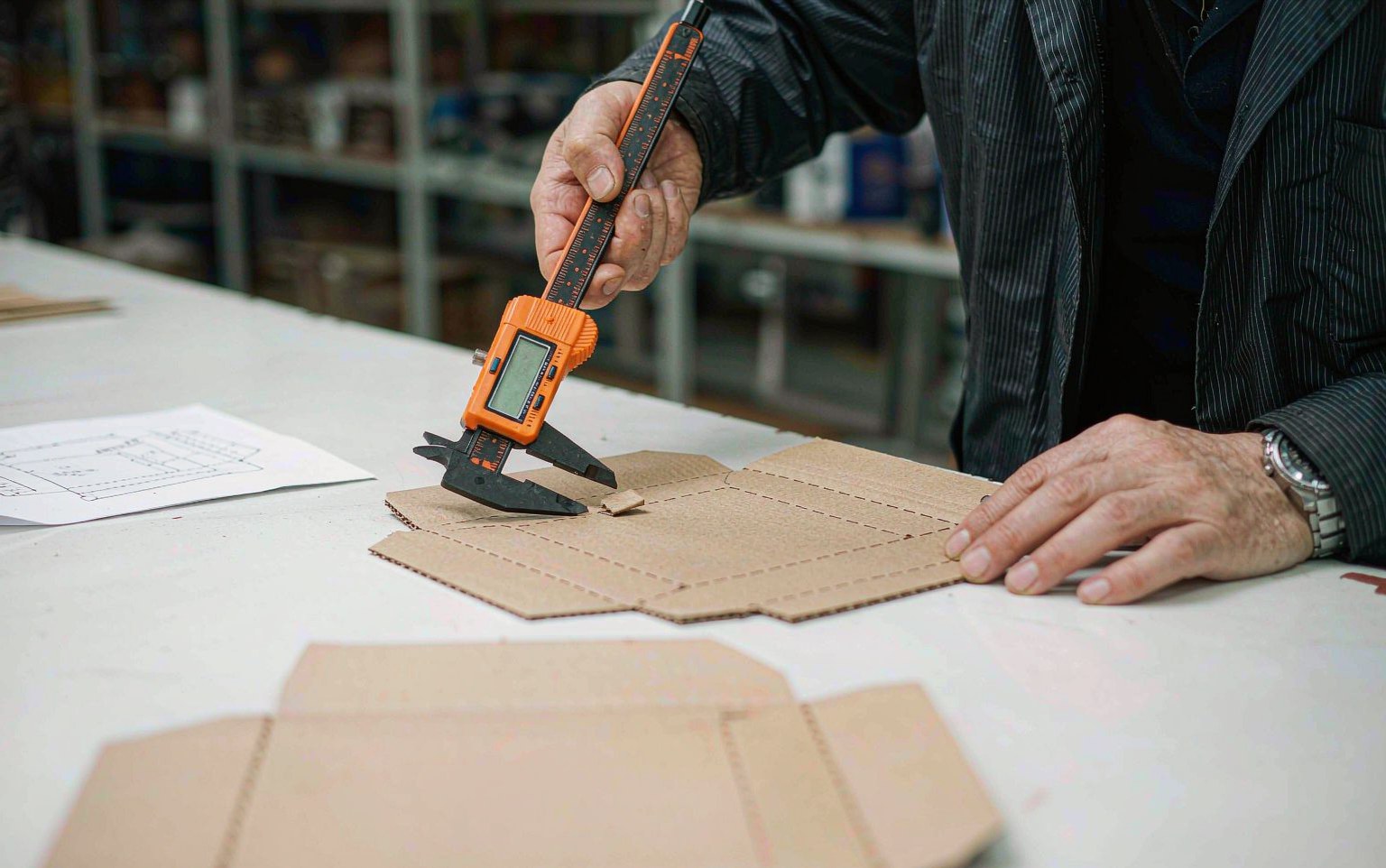
Incoming inspection does not need a metrology lab. A calibrated digital caliper, a flat surface and ten minutes per lot catches most problems before they reach the magazine:
Ten minutes at goods-in routinely saves hours of stoppage. Plants that skip incoming inspection usually discover tolerance problems as "mystery jams" that disappear when a new carton lot arrives.
Before writing a complaint to the carton supplier, rule out the machine. The same symptoms can come from setup drift: a magazine back plate opened a few tenths during the last changeover, vacuum pickup nozzles worn smooth, pusher stroke out of position, or bucket pitch never re-verified after a chain service. A quick check is to feed a retained first-article blank from the lot that ran perfectly at commissioning — if symptoms persist with a known-good blank, the machine needs attention; if they vanish, the current carton lot is the suspect.
It also pays to quantify what tolerance drift costs in output. A line losing 5 minutes per hour to carton-related micro-stops is not running anywhere near rated capability — the gap between rated speed and real output is mostly made of exactly these small interruptions.
Blank consistency also feeds machine selection. High-speed cartoners such as the MTK-150H high-speed automatic cartoning machine reward suppliers who hold tight bands, because feed rates amplify every deviation.
For machine-fed cartons, ±0.25 mm on critical crease-to-crease dimensions and ±0.5 mm on flap lengths, width and side-seam position are common working bands. Heavy or microflute boards usually need slightly wider bands. Always defer to your cartoner supplier’s blank specification, which is written around the machine’s feeding and closing system.
Responsibility follows the agreed specification. If critical dimensions and bands were defined in the drawing and the blanks exceed them, it is a supplier issue. If tolerances were never agreed, the buyer typically shares the cost of resolution — which is why the spec-sheet review and first-article sign-off matter more than any single measurement.
Within limits. Setters can bias magazine gaps, pickup positions and closing rails to compensate for a lot that sits consistently at one edge of the band. What no setup can fix is a lot that straddles both edges, or blanks with squareness and crease-quality defects — those return as jams no matter how the machine is tuned.
Inspect every new lot at goods-in, and again after any storage period longer than a few weeks in uncontrolled humidity. A 10-blank sample per lot with recorded measurements is enough for most plants; increase sampling whenever a new carton supplier, die or board grade is introduced.
Die-cut tolerances are unglamorous, but they decide whether a cartoning line runs at rated speed or spends its shifts clearing jams. Agree tight bands on the dimensions machines actually touch, inspect every lot at goods-in, and keep retained blanks as your setup reference. If you are specifying a new cartoner or struggling with a carton that will not cooperate, send us your product and carton details for a quote — our engineers will review the blank specification against the machine before you commit to either.