REQUEST A QUOTE
When a cartoning machine stops, the cost is never just the part. Every hour a line stands still can cost a mid-size manufacturer thousands of dollars in lost output, overtime, and missed shipments. Yet in most downtime reviews we run with customers, the root cause is painfully simple: nobody stocked the part. A forty-dollar suction cup or a hundred-dollar timing belt can idle a machine worth six figures.
This guide gives you a practical cartoner spare parts plan: which items actually wear out, realistic replacement intervals, sensible stock levels for a single machine, and the audit process we recommend before you place your first order.
When buyers compare cartoning machines, speed is usually the first specification on the shortlist. But after commissioning, uptime depends far less on rated speed than on how quickly you can restore the machine when something wears out. Two identical lines with the same rated output can deliver very different annual volumes purely because of spare parts strategy.
The math is unforgiving. If a wear part fails and the replacement is on a shelf in your maintenance room, the stoppage is measured in minutes. If the same part has to ship from overseas, the stoppage is measured in weeks. For machines imported from China, standard air freight plus customs clearance commonly adds two to four weeks to any emergency order — and that assumes the manufacturer has the part on hand at all.
A spare parts plan is essentially cheap insurance. One modest initial order typically costs less than a single day of unplanned downtime on a busy packaging line.
Consider a realistic scenario. A cosmetic manufacturer runs a cartoner for two shifts per day. A vacuum cup for carton pickup cracks on a Friday afternoon. The machine runs, but misfeeds spike from near zero to several cartons per thousand. The operator slows the machine to compensate, cutting output by fifteen percent. The replacement cup arrives ten days later. The total loss: roughly ten days of reduced throughput, several hours of rework on poorly sealed cartons, and a maintenance team that spent more time babysitting the machine than maintaining it.
None of this shows up as a dramatic breakdown, which is exactly why spare parts planning gets neglected. The full financial picture — including the labor cost of running a machine below its rated speed — is covered in detail in our automatic cartoner cost breakdown, and the same logic applies to wear items, not just the purchase price of the machine.
Not all spare parts deserve the same treatment. It helps to split your list into two categories.
Wear items degrade predictably with every cycle: belts, suction cups, glue hoses, seals, springs, chain inserts, and cutting components. They are inexpensive, they fail gradually or suddenly at high cycle counts, and they should almost always be stocked on site. Two or three of each is usually enough for a single machine.
Capital spares are expensive components that rarely fail: servo motors, variable frequency drives, the PLC, the HMI panel, and the main gearbox. Holding a full set of capital spares for one machine ties up cash for a failure that may never occur. For these, the smarter strategy is to agree on a guaranteed lead time with your supplier, keep one critical spare if your line is a bottleneck, and rely on condition monitoring to catch degradation early.
A practical rule: stock everything under roughly two hundred dollars per unit; negotiate lead-time guarantees for everything above it.
Timing belts synchronize the carton feeding, opening, and closing stations, so a stretched or cracked belt shows up first as registration drift: flaps tucked unevenly, glue lines landing off-position, cartons jamming at the closing station. Inspect belts monthly for glazing and tooth wear. Most cartoners use standard profiles, but belt length and tooth count are machine-specific, so order from the machine manufacturer's part list rather than matching by eye.
Suction cups do the most delicate job in the machine — separating a single blank from a stack and opening it. They are also among the cheapest parts and the most common cause of misfeeds. Flat cups on blank pickup typically last three to six months in continuous duty; bellows cups on opening stations wear faster because they flex every cycle. Stock at least one full set plus two spares of each cup type, and replace the whole set at the first sign of uneven wear rather than one cup at a time.
Hot melt glue systems consume hoses, filters, and nozzles on a fixed schedule. Clogged nozzles cause skip patterns and open flaps; degraded hoses cause pressure instability and stringing. Because glue symptoms mimic so many other faults, we recommend reading our glue system troubleshooting guide alongside this list — most of the eight problems described there start as a consumable issue. Keep two spare nozzles per glue point, one spare hose, and a nozzle cleaning kit on hand.
The tucking and closing station is where mechanical force concentrates. Springs lose tension, cam followers develop flat spots, and pressing plates wear where carton flaps contact them. Symptoms appear as inconsistent tuck depth or flaps that pop open after gluing. These parts are inexpensive, but they are often format-specific, so confirm the part numbers against your current carton format before ordering. Lid-and-base formats raise the stakes further: on machines like the MTK-VC160 / VC260 top-opening lid box packing machine, worn closing components show up immediately as lids that sit crooked or fail the drop test.
Proximity and photoelectric sensors fail occasionally and fail completely when they do, so one spare of each sensor type is a sensible minimum. Guide rails and chain inserts for the carton transport conveyor wear continuously and are cheap to replace in time — a worn rail insert quietly causes the carton skew that leads to jams downstream. Keep one or two rail sets for your production format. On high-speed machines such as the MTK-150H high-speed automatic cartoning machine, cycle counts accumulate fast, so inspection intervals should be shortened accordingly.
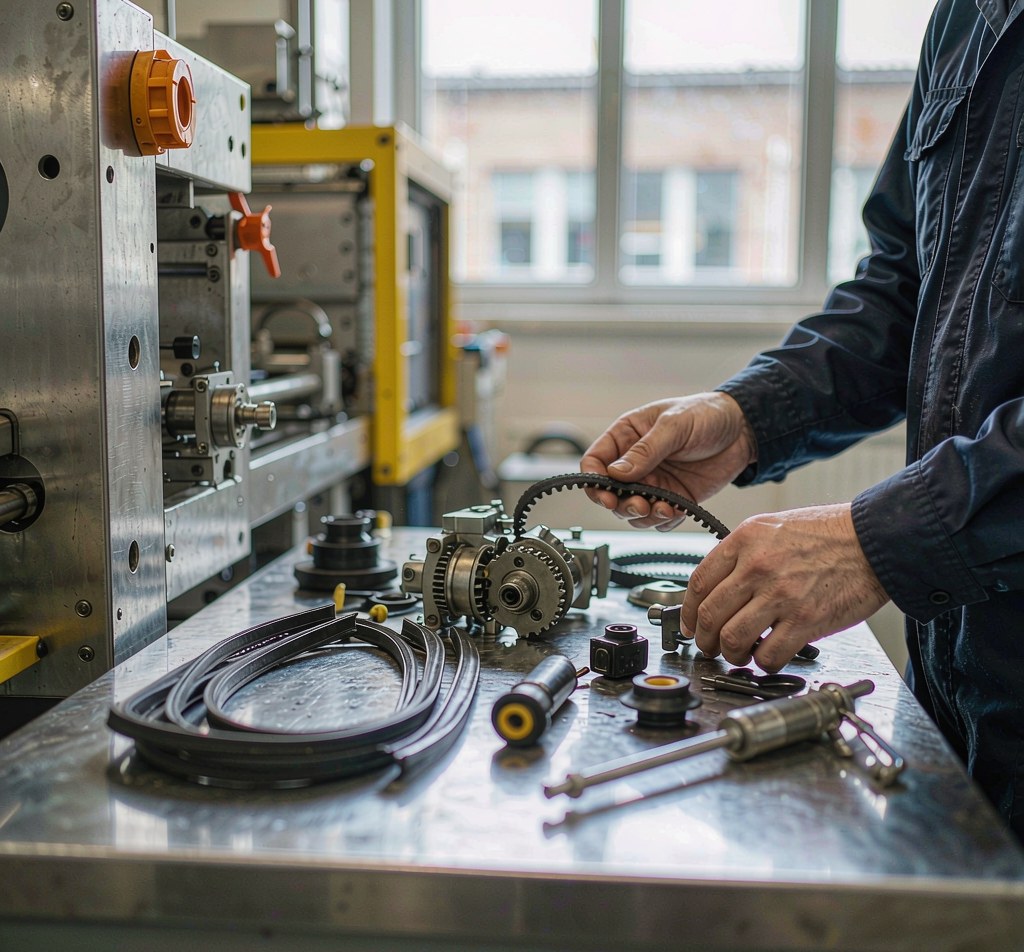
The table below reflects what we ship with machines and what our service team recommends adding for a single cartoner running one or two shifts per day. Scale up proportionally for multi-machine lines.
| Wear Part | Typical Service Life | Failure Warning Signs | Suggested Stock (1 machine) |
|---|---|---|---|
| Blank pickup suction cups | 3–6 months | Double blanks, misfeeds at infeed | 1 set + 2 spares |
| Carton opening bellows cups | 2–4 months | Cartons opening only halfway | 1 set + 2 spares |
| Timing belts | 12–24 months | Registration drift, flap misalignment | 1 full set + 1 of each type |
| Glue nozzles | 3–6 months | Skipped glue lines, stringing | 2 per glue point |
| Glue hoses and filters | 6–12 months | Pressure fluctuation, bead instability | 1 hose + 2 filters |
| Closing station springs and cams | 12–18 months | Uneven tuck depth, flaps reopening | 1 full set |
| Guide rails and chain inserts | 12–24 months | Carton skew, transport jams | 1 set for main format |
| Proximity / photo sensors | 24–36 months | Random stops, missed detection | 1 of each type |
There are two philosophies for replacing wear items. Time-based replacement swaps the part at a fixed interval — every six months, say — regardless of condition. Condition-based replacement inspects the part and swaps it only when measurements show wear. In practice, the best programs mix both.
Use time-based replacement for anything whose failure stops the machine outright and whose cost is trivial: suction cups, glue nozzles, filters. The parts are so cheap that over-replacing them costs almost nothing, while under-replacing them costs a stoppage.
Use condition-based management for belts, rails, and closing components. Inspect them on the schedule in your cartoning machine maintenance checklist, record measurements (belt tension, rail depth, spring free length), and replace when the trend crosses a threshold — not when it fails. Trend data also tells you whether your application is harder on parts than average; a line running dusty pharmaceutical board will wear cups far faster than a line running coated cosmetic cartons.
Before ordering anything, walk the machine with the manual and record three things for every wear part: the manufacturer part number, the quantity installed, and its current condition. Photograph each station. This thirty-minute audit prevents the two most common ordering mistakes: buying the wrong revision of a part, and buying parts for a format you no longer run.
The best moment to do this audit is during commissioning or a scheduled service visit, when the machine is already open and the supplier's engineer is on site. If you are still evaluating a purchase, make the spare parts package and its pricing part of the negotiation — our installation and commissioning guide explains which acceptance documents, including the recommended spares list, you should receive before final payment.
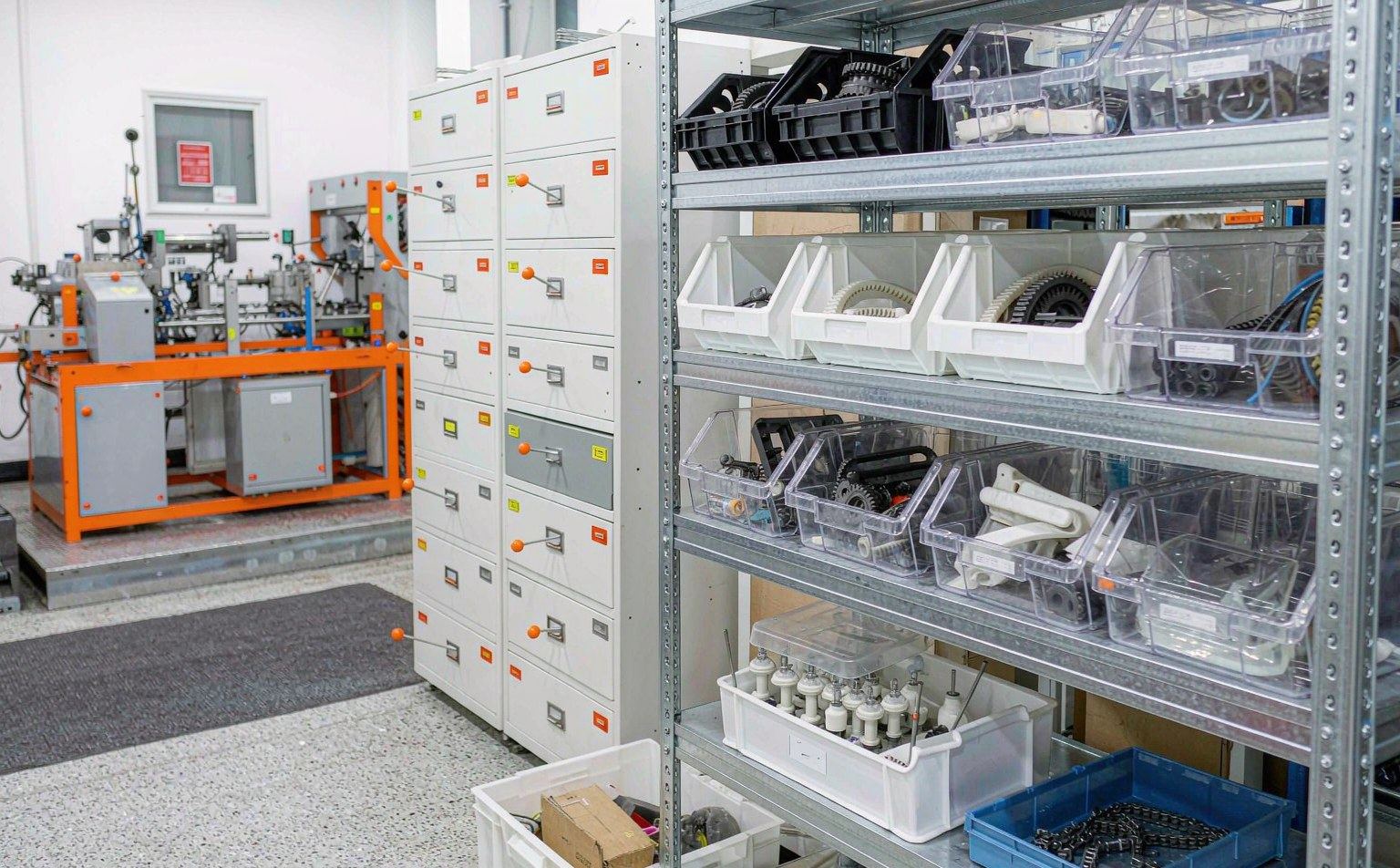
A spare parts shelf is useless if nobody can find the right part at 11 p.m. Label every bin with the part number and the machine station it belongs to, not just the part name. Keep rubber parts (belts, cups, hoses) away from sunlight, ozone sources like older motors, and temperature extremes — rubber degraded by poor storage fails early even when it looks new. Glue nozzles should be stored cleaned and capped.
Assign ownership. One person should track stock levels and reorder triggers, ideally tied to the maintenance schedule rather than waiting for a failure to reveal an empty bin. A simple spreadsheet with minimum-quantity alerts is enough for most plants; the discipline matters more than the software.
Third-party belts, bearings, and standard sensors are often perfectly adequate and significantly cheaper — a good industrial supplier can match most timing belt profiles without the OEM markup. Where we recommend genuine parts is anywhere the part defines machine behavior: format-specific cams, closing plates, vacuum assemblies designed for your blank geometry, and anything in the glue system where an off-spec component changes bead placement.
The pragmatic split: buy commodity parts from local industrial distributors for speed, and keep a small OEM emergency kit for the parts that only the machine builder can supply correctly. When requesting parts from us, include the machine serial number and format — it prevents the wrong-revision problem entirely. You can start through our request a quote page and attach photos of the parts you need.
Four patterns cause most spare parts regrets. First, stocking only for the format in production: when a new carton format launches six months later, its change parts and rails were never ordered. Second, treating the spares list as a one-time purchase — wear rates drift, so review the list annually. Third, storing parts loosely without labels, which converts a stocked part into a lost part. Fourth, replacing wear items one at a time instead of in matched sets, which leaves the machine running on a mix of new and worn components and makes symptoms nearly impossible to diagnose.
For a standard automatic cartoner, a sensible initial wear-parts package usually lands between one and three percent of the machine price. That covers two sets of the highest-churn items and one set of medium-life items. Machines with glue systems and complex closing stations sit at the top of that range.
In our service records, blank pickup and opening suction cups cause the most stoppages by count, and timing belts cause the longest stoppages when not stocked. Both are cheap — there is no reason either should ever idle a machine.
Yes, and by a wide margin. Clean vacuum filters weekly, keep glue system pressure within spec, align belts correctly at installation, and lubricate cam followers on schedule. Well-maintained wear items routinely last fifty percent longer than neglected ones. Reducing changeover handling also helps, since many parts are damaged during format changes — the quick-change practices in our SMED changeover guide reduce that risk.
Common wear items are shipped within two to three working days by air courier, and most reach North America, Europe, or Southeast Asia within one to two weeks door to door. For critical lines we recommend keeping the initial package on site rather than relying on any supplier's shipping speed — even the fastest courier cannot compete with your own shelf.
Building a spare parts plan takes one audit and one purchase order, and it protects every hour of production your cartoner runs afterward. If you want a spare parts package sized to your machine and formats, contact our team with your model and carton specifications — we will return a priced list within one working day.