
REQUEST A QUOTE
Buying your first cartoning machine is a six-figure-adjacent decision made against a wall of conflicting quotations, unfamiliar terminology, and salespeople promising 300 boxes per minute. This guide distills what we've learned delivering 300+ cartoning lines since 2014 into a plain-language roadmap: what to check, what to ignore, which questions to ask, and the five mistakes first-time buyers make most often.

Honest question first. Automatic cartoners pay for themselves at volume — below that, they sit half-idle:
| Your Daily Output | Recommendation |
|---|---|
| Under 2,000 cartons/day | Manual packing — automation rarely pays back yet |
| 2,000 – 8,000 cartons/day | Semi-automatic cartoner or entry automatic |
| 8,000 – 30,000 cartons/day | Automatic intermittent-motion cartoner — the sweet spot for most buyers |
| 30,000+ cartons/day | Continuous-motion or servo high-speed, possibly multi-lane |
If you're in the gray zone, our fully automatic vs semi-automatic comparison walks through the trade-offs in detail.
Every machine selection starts here — not with machine catalogs:
Any serious supplier will send this; run it yourself before they do:
Required cartons/min = (products per minute ÷ products per carton) × 1.25
The 1.25 factor covers changeovers, rejects, and operator reality. Then hold the line: rated speed ≠ delivered speed. A machine rated at exactly your target will spend its life below it. A credible quote shows the calculation, not just a top speed lifted from the brochure.
You'll meet these terms in every quotation. Here's what each actually means for you:
| Decision | Options | What Drives the Choice |
|---|---|---|
| Orientation | Horizontal / vertical | Product shape — flat packs lie horizontally; bottles stand vertically. Details in our horizontal vs vertical guide |
| Motion | Intermittent / continuous | Intermittent is cheaper and fine under ~60/min; continuous for higher speed and fragile products |
| Changeover | Manual / quick-change / servo-auto | SKU count — under 3 SKUs manual is fine; daily changeovers justify servo |
| Sealing | Tuck / glue / combi | Market requirements: tuck for retail cosmetics & food, glue for pharma and export |
For the full selection framework, read how to select the right cartoner for your factory.
A quotation that says "automatic cartoning machine, $28,000" is not a quotation. It should list:
Price context helps too: entry automatic cartoners from Chinese factories run roughly $12,000–$30,000, mid-range $30,000–$80,000, high-speed servo $60,000+. Our complete cost breakdown details every line item including tooling, shipping, and commissioning.
The single most valuable step beginners skip. Before shipment, insist on a video (or live) trial using your actual products and carton blanks. Evaluate:
A supplier who hesitates to run your samples before payment is telling you something. We run trials as standard because they protect both sides — and they routinely surface a carton design tweak that saves months of frustration.
| Phase | Duration |
|---|---|
| Quotation + configuration proposal | 1–3 days |
| Sample trial + contract | 1–2 weeks |
| Manufacturing | 30–60 days |
| Sea freight | 15–35 days depending on destination |
| Installation + commissioning + training | 2–5 days |
| Total | ≈ 2.5–4 months |
Plan your packaging material inventory and staffing around this timeline — and place the machine order before your manual packing line becomes the growth bottleneck.
For an entry automatic machine: $12,000–$30,000 for the machine plus 15–30% for tooling, spares, freight, and commissioning — so budget roughly $16,000–$40,000 total first-year investment. Full math in our cost breakdown guide.
Quality depends on the manufacturer, not the country. Vet for: real factory (video tour), named-brand components, CE marking, willingness to trial your samples, and reference customers in your industry. A transparent supplier will offer all five without being asked.
Some modules retrofit, but integration costs more than factory-fit and may require firmware changes. If there's any chance you'll need leaflets, batch coding, or rejection systems, spec them into the original build — the delta is small at order time and large afterward.
The carton size envelope and the guaranteed speed with YOUR product at YOUR carton. Everything else is negotiable; these two define whether the machine fulfills its purpose.
Mattkay (MTK) has guided first-time buyers through 300+ cartoning line projects since 2014 — ISO9001 & CE certified, 30+ patents. Send us your product photos and target output, and we'll reply with an honest configuration — even if it means recommending a smaller machine than you expected: Request a Free Consultation.
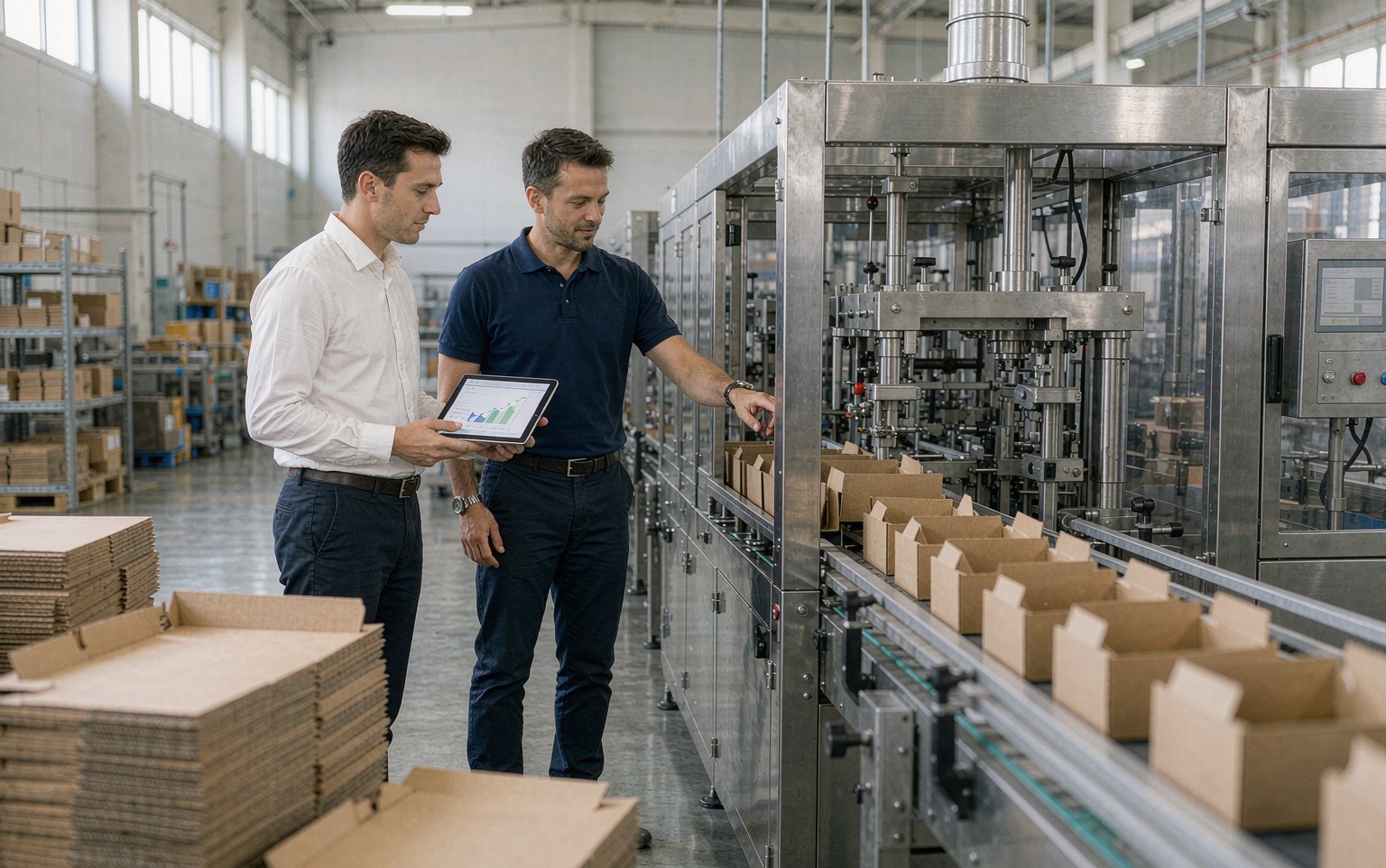

[…] manufacturers considering an automatic cartoning machine, early engineering review can help identify feeding challenges, reduce installation changes, and […]