REQUEST A QUOTE
Infant formula is one of the most demanding cartoning applications in the packaging industry. A milk powder carton protects a product that is expensive, hygroscopic, and consumed by the most vulnerable end users in the market — infants. Buyers searching for an infant formula cartoning machine are therefore not comparing box-packing speeds alone; they are evaluating counting accuracy, hygiene design, scoop and leaflet insertion, traceability, and how reliably a line runs two or three shifts a day.
This guide explains how an infant formula cartoning line is built, which features actually matter in daily production, how to calculate the speed you need, and which configuration choices determine both the price and the long-term reliability of the machine. The examples are drawn from the vertical cartoning systems we build at Mattkay for dairy and nutrition customers.
On paper, a formula tin or carton looks like any other rigid box application. In practice, four constraints separate formula from general food cartoning:
Because of these constraints, infant formula lines are usually engineered as a dedicated line concept rather than assembled from generic machines. The cartoner is the center of that line, but it succeeds or fails together with the filling and inspection equipment around it.
A complete milk powder cartoning line generally follows this sequence:
1. Powder dosing and filling. An auger filler doses the powder into the carton — or into a bag or tin that is later boxed. Dosing accuracy at this stage determines everything downstream; the cartoner can only pack what it receives.
2. Scoop and accessory insertion. Scoops are fed from a bowl feeder or magazine, oriented, and inserted either before or after the powder, depending on the carton design. Levelers and desiccant, where used, are inserted at the same station group.
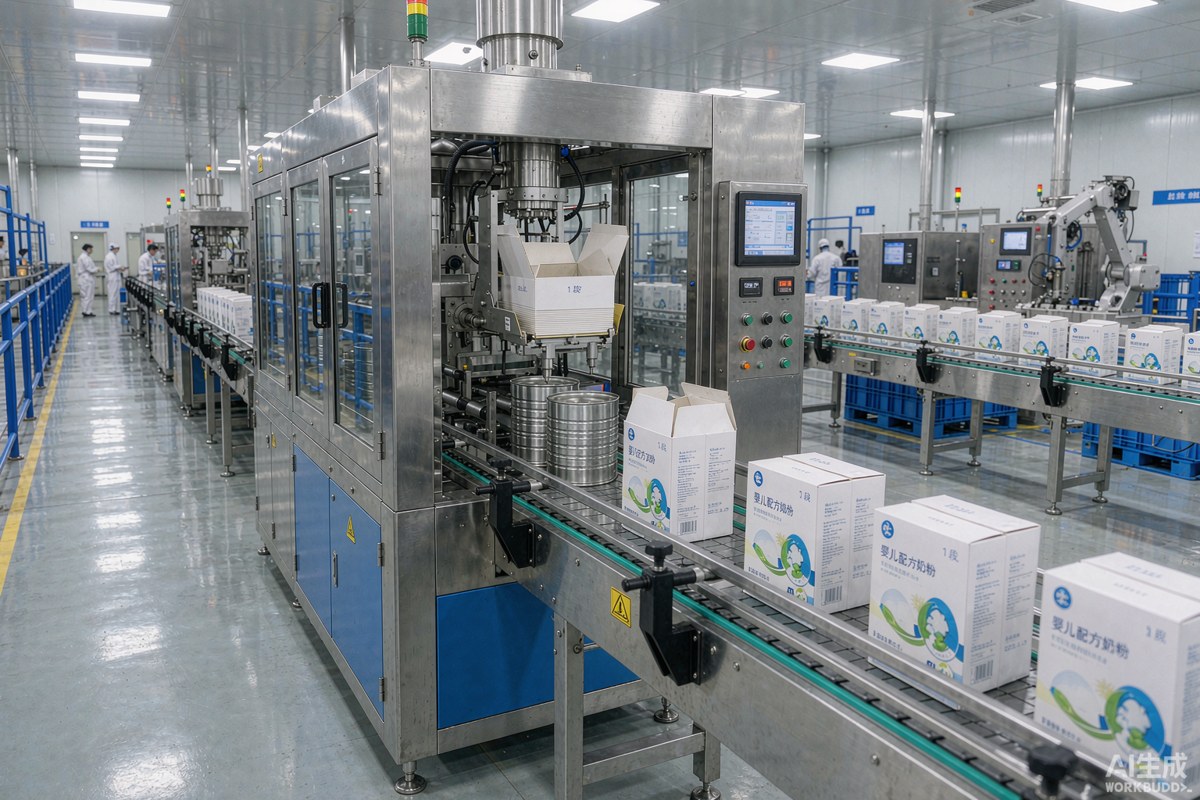
3. Cartoning. The cartoner opens the flat blank, receives the filled carton body or the product set, and closes the box with tuck, glue or lock-bottom configuration. For vertical formats the product drops downward into an upright carton; this is the configuration most dairy lines choose, and our MTK-VC160 vertical cartoning machine is built exactly for this kind of counted, gravity-fed application.
4. Coding and verification. Batch number and expiry date are printed and verified. Vision systems confirm scoop presence, lid position and carton closure. In premium markets, serialization may also be required.
5. Case packing and palletizing. Finished cartons are grouped and packed into shipper cases. Our overview of cartoning versus case packing explains how these two machine types divide the work at the end of the line.
Formula producers most often select vertical cartoning, for three practical reasons:
Horizontal cartoners remain the right choice when the formula is packed as finished rigid items — for example sealed tins or flow-wrapped blocks — that can be pushed sideways without damage. Our full comparison of horizontal versus vertical cartoning machines walks through that decision in detail.
A useful rule of thumb: if the product is dosed into the carton on the line, choose vertical. If the product arrives already sealed and only needs boxing, horizontal usually wins.
Marketing sheets list dozens of features. In daily formula production, these are the ones that decide whether the line runs or stalls:
Whether the cartoner receives product from a multihead weigher, an auger or a counting system, the infeed must deliver the correct quantity, orientation and sequence — every cycle. Missing or double scoops are the most common complaint in this sector, so the scoop feeder deserves as much engineering attention as the powder filler. Our guide to integrating a cartoner into a production line covers the upstream feeding checks to run before signing a contract.
Look for sealed bearings outside the powder zone, positively driven guides that cannot accumulate dust, sloped surfaces that shed powder, and covers that open tool-free for daily cleaning. A machine that needs an hour of disassembly to clean will quietly lose you production every shift.
Formula brands come in stages (Stage 1–4), languages and pack sizes. A servo machine that recalls recipes from the HMI cuts changeover from hours to minutes. Our analysis of cartoning machine changeover time shows how this pays back quickly for plants running many SKUs.
Formula cartons typically use glue-sealed or lock-bottom construction for tamper evidence and stack strength. Confirm your carton supplier can supply consistent blanks; poor blanks cause more downtime than weak machines — our cartoning machine troubleshooting guide lists the failure modes to check first.
Stainless steel frames in the product zone, food-grade contact materials, and washdown-compatible electricals are standard for dairy. Ask for material certificates, not just "food grade" claims.
Formula lines are usually speed-limited by the filler, not the cartoner — but the cartoner must still be sized with headroom. The basic calculation:
Required cartons/min = filling output per minute ÷ cartons per filling cycle × 1.2
Worked example: your auger filler completes 40 fills per minute and each carton receives one fill. With a 20% allowance for changeovers and micro-stops, you need a cartoner rated for roughly 48–50 cartons per minute at your actual carton size. Our cartoning machine speed calculation guide shows how to convert rated speed into realistic output for different formats.
For a typical mid-size dairy plant running two shifts, this lands in the 40–80 cartons per minute range — exactly the window where vertical intermittent-motion machines offer the best price-to-performance.
From our service records, the five most frequent issues are:
A structured daily-to-monthly maintenance checklist prevents most of these from developing at all.
As a factory-direct manufacturer, we price each line around the actual product and carton specification, so published numbers are indicative only. As a planning reference: a dedicated vertical cartoner for counted, fill-from-above applications typically starts in the entry five-figure range in USD, while a complete formula line — dosing, scoop insertion, cartoning, coding, verification and case packing — is a six-figure project.
For a full breakdown of what drives machine pricing, see our cartoning machine cost breakdown, and for the payback logic specific to food plants, our ROI and payback period guide. Most formula producers justify the investment through labor reduction plus the elimination of underfill and missing-component complaints.
Yes, if the carton size range of all SKUs fits within the machine's envelope and the machine has servo recipe storage. Stage variants usually share carton dimensions; language variants only change the print, which is handled by your carton supplier or an inkjet coder.
We integrate complete lines and match the scoop feeder, leveler feeder and inspection equipment to the cartoner's infeed — a single point of responsibility for line performance. For the machine-only scope, we specify the interface requirements your equipment must meet.
Sealed tins are better boxed on a horizontal machine or a dedicated case packer, because a filled tin is heavy and stable. Vertical machines excel when the product is dosed into the carton on the line.
Carton dimensions (min–max), carton style, product weight and format, number of SKUs, target output, and whether scoop/leaflet insertion is required. Samples of the carton blank and product make the quotation far more accurate.
Through design: sloped stainless surfaces, sealed bearings, tool-free covers and CIP-compatible zones where required. Daily cleaning follows the checklist routine in our maintenance guide.
If you are planning a formula packaging line, start by defining the carton and component set, then test real blanks and product on the machine before ordering. For a broader foundation, our complete explainer on what a cartoning machine is and how automatic cartoning systems work covers the full machine landscape, and our blister pack cartoning guide covers the nutrition-adjacent supplement sector.
Not sure which configuration fits your product? Send us your carton size and product samples — we will run them on the machine and send you the video, then quote the exact configuration.
Machines that match this guide
Not sure which model fits your product? Send your carton size and product sample and we will recommend the right configuration.