REQUEST A QUOTE
Artificial intelligence (AI) is becoming a serious topic in industrial packaging. From machine vision inspection to predictive maintenance, AI can help manufacturers detect quality issues earlier, analyze machine data, and make better production decisions. However, AI is not the same as conventional automation — and knowing the difference is the first step toward choosing the right equipment for your factory.
In this guide, you will learn what AI actually does in packaging machinery, where it delivers real value on an automatic cartoning machine, what its limitations are, and how to evaluate AI features when comparing suppliers.
AI in packaging machinery refers to technologies that analyze data, recognize patterns, or support decisions during packaging operations. Depending on the application, these technologies work alongside sensors, cameras, programmable logic controllers (PLCs), and factory software such as MES or SCADA systems.
In practice, most "AI" in packaging equipment today falls into three categories:
Traditional automation follows predefined rules and programmed sequences — and for most cartoning tasks, that is exactly what you want. A sensor detects whether a carton is present; a PLC confirms the flap is folded; the machine ejects a rejected box. These binary checks are reliable, fast, and inexpensive.
AI adds value where fixed rules reach their limits. A trained vision system can identify subtle defects — a misprinted date code, a slightly skewed label, a deformed carton corner — that are difficult to describe as simple yes/no rules. Predictive algorithms can notice that a sealing cylinder is taking 0.3 seconds longer than its historical average, days before it fails.
The right approach depends on the inspection task, the production environment, and the accuracy you actually need. Do not pay for AI where a €50 sensor solves the problem — and do not rely on fixed rules where a trained model will catch what operators miss.
AI-enabled vision systems inspect product orientation, packaging appearance, label placement, date codes, and visible defects. On a cartoning line, vision verification is commonly used at three points:
Compared with traditional fixed-camera checks, trained models handle natural variation better — different print shades, reflections, or acceptable product tolerances — which reduces both false rejects and missed defects.
Predictive maintenance uses equipment data to identify signs of component deterioration before failure occurs. Temperature, vibration, motor current, and cycle-time trends all feed the model.
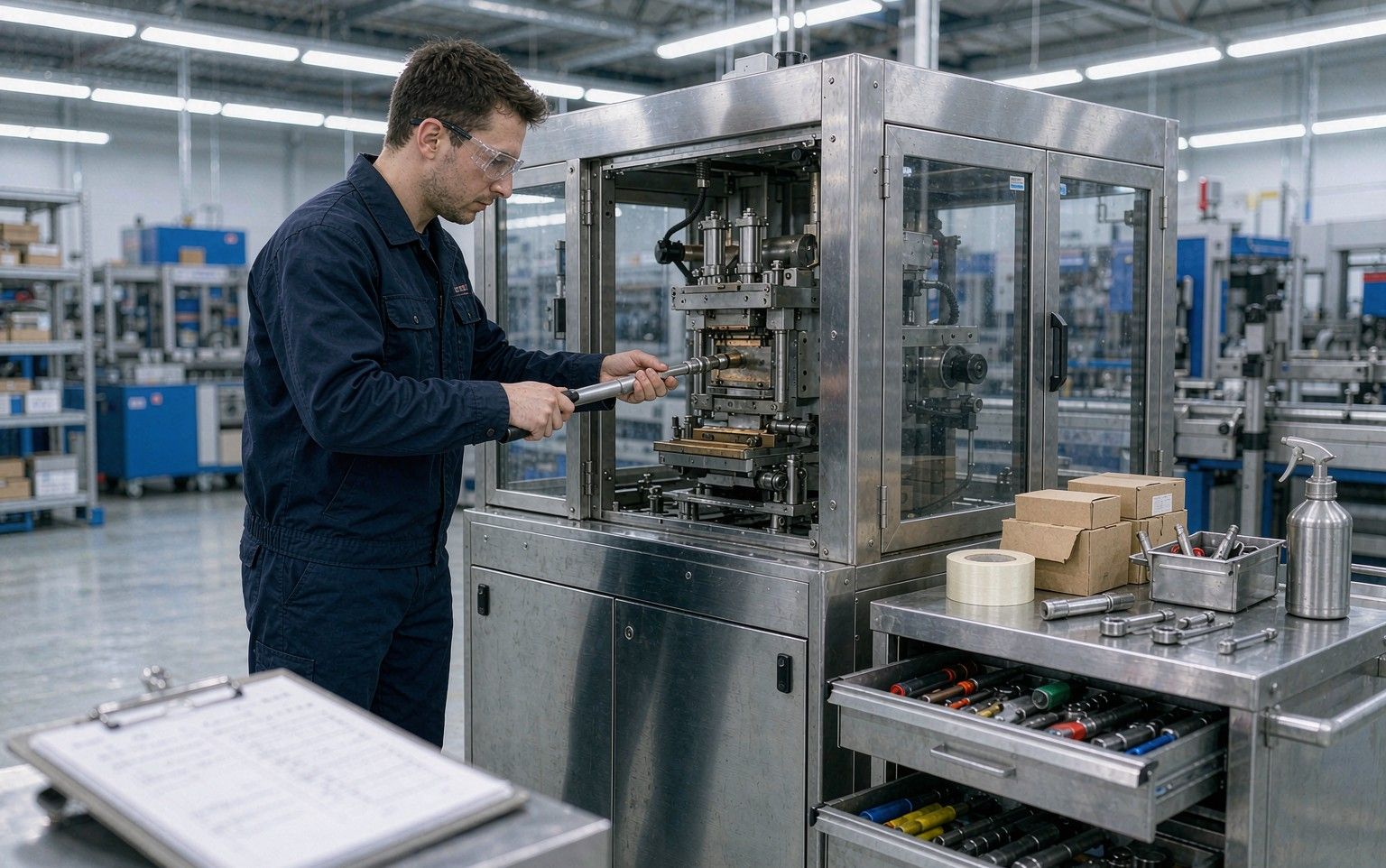
For a packaging line, the practical benefit is scheduling: instead of reacting to a jammed sealing station mid-shift or over-servicing machines on a fixed calendar, maintenance happens when the data says it should. This works best when combined with a disciplined daily, weekly, and monthly maintenance routine — AI complements good maintenance habits, it does not replace them.
Be realistic about what predictive maintenance can do: it does not eliminate breakdowns, and useful predictions require reliable data and proper validation over weeks of real production.
AI-driven analytics aggregate data across the line — output, micro-stops, rejection rates, changeover durations — and turn it into interpretable dashboards. Instead of a raw error log, the system highlights the three fault patterns that cost you the most output this week.
On a cartoner, this typically surfaces issues like recurring micro-stops on the carton magazine, speed losses after changeovers, or a feeding station that degrades progressively through a shift. Once quantified, these problems can be fixed mechanically — see our guide to the 12 most common cartoning machine problems and how to fix them.
Modern HMIs increasingly embed guided diagnostics: when a fault appears, the system suggests the likely cause, the affected station, and the corrective steps — drawn from historical fault-resolution data. For factories with high operator turnover, this shortens the learning curve considerably and reduces dependence on one senior technician.
AI-assisted changeover systems store validated recipe parameters per SKU — pusher positions, carton dimensions, sealing temperature, timing offsets — and apply them automatically at product change. Advanced versions verify the result with vision confirmation on the first cartons and fine-tune within tolerance. For manufacturers running many SKUs per day, saved changeover minutes compound into significant weekly output, a topic closely related to our rated speed vs. real output calculation.
Vision systems are the most mature AI application for cartoners. Typical configurations verify carton presence and orientation in the magazine, product alignment before insertion, leaflet presence for pharma-style applications, and final carton print quality. Integration matters more than the algorithm: the camera must trigger at the right machine angle, and rejected cartons must be removed without stopping the line.
Servo-driven cartoners generate rich operational data — torque profiles, axis positions, cycle times. AI monitoring learns the "healthy signature" of each motion and flags deviations. A gradually rising torque on the carton-opening suction arm, for example, indicates wear before cartons start failing to open.
AI delivers most value when it sees the whole line, not one machine in isolation. Sharing rejection data upstream and downstream prevents cascading faults — for example, alerting the upstream feeder when carton jams correlate with product spacing irregularities. Line-level integration is a core engineering task, covered in detail in our guide to integrating a cartoning machine into a production line.
Honest expectations protect your investment:
| AI can | AI cannot |
|---|---|
| Catch visual defects that fixed rules miss | Fix poor machine design or bad mechanical condition |
| Predict wear based on data trends | Work without weeks of quality training data |
| Reduce operator workload and skill requirements | Replace the need for trained maintenance staff entirely |
| Quantify where your output is being lost | Guarantee uptime — sensors and cameras still fail |
If your current challenge is more fundamental — choosing between automation levels or machine types — start with the basics: compare fully automatic vs. semi-automatic cartoning machines and horizontal vs. vertical cartoning machines before adding AI on top.
Start from the pain point, not the technology. Is it defect escapes? Unplanned downtime? Slow changeovers? High operator turnover? Each problem maps to a different AI application — and some problems are best solved mechanically.
Ask exactly what is included: camera resolution and lighting, computing hardware, software licenses, update policy, and whether models are trained on your products or generic. Get the full specification in writing before comparing prices — our cartoner cost breakdown explains how these options affect total investment.
Run your products and your cartons through the proposed inspection or monitoring system. A demonstration on the supplier's demo product proves little; a trial on your actual SKUs — including your worst-case product — proves everything.
Confirm who configures the AI system, how it communicates with your existing PLCs and factory systems, and what happens when it needs retraining after a product change. A practical framework for structuring these questions is available in our cartoning machine buying guide.
If you are new to AI in packaging, the pragmatic path is: start with vision inspection at the final carton check, add OEE dashboards to quantify your losses, and only then consider predictive maintenance. This sequence generates measurable value at each step and builds the data foundation for more advanced applications.
For a broader equipment-first perspective, read how to select the right automatic cartoner for your factory — automation level, feeding system, and machine structure matter more to your ROI than any AI badge.
Three trends are worth watching. First, vision models are becoming lighter and faster to train, making custom inspection affordable for mid-size factories. Second, machine builders are moving toward open data standards, so line equipment from different vendors can share diagnostics. Third, robotic feeding combined with AI grasping is expanding the range of products a cartoner can handle without custom tooling — soft, irregular, and variable products that previously required manual loading.
None of these trends change the fundamentals: a well-built machine with correct specifications still outperforms a mediocre machine with AI bolted on.
The main uses are machine vision quality inspection, predictive maintenance, production data analysis (OEE), operator support diagnostics, and AI-assisted changeovers. Vision inspection is currently the most common and most mature application.
No. A standard automatic cartoner with PLC control and basic sensors handles the vast majority of cartoning applications reliably. AI adds value for high-speed lines, strict quality requirements, multi-SKU operations, or factories pursuing continuous data-driven improvement.
Usually yes — retrofit vision systems and standalone OEE monitoring are the most common retrofits. The machine must provide the necessary I/O signals and mounting space, so confirm compatibility with the original manufacturer first.
Define one measurable problem (e.g., defect escape rate or unplanned downtime), request a trial with your real products, set a clear success metric, and expand only after the first application proves its payback.
Trained vision models handle natural product variation better than fixed-rule systems, which is precisely their advantage. However, extreme variation still requires careful camera placement, lighting design, and model validation on a large sample set.
Not sure whether AI features make sense for your products and volumes? Send us your product and carton specifications — our engineers will recommend the configuration that matches your actual production needs, without upselling technology you will not use.
Machines that match this guide
Not sure which model fits your product? Send your carton size and product sample and we will recommend the right configuration.